_edited.jpg)
Best Fun Mandarin Class for Kids in Singapore: A 2026 Nurturing Guide
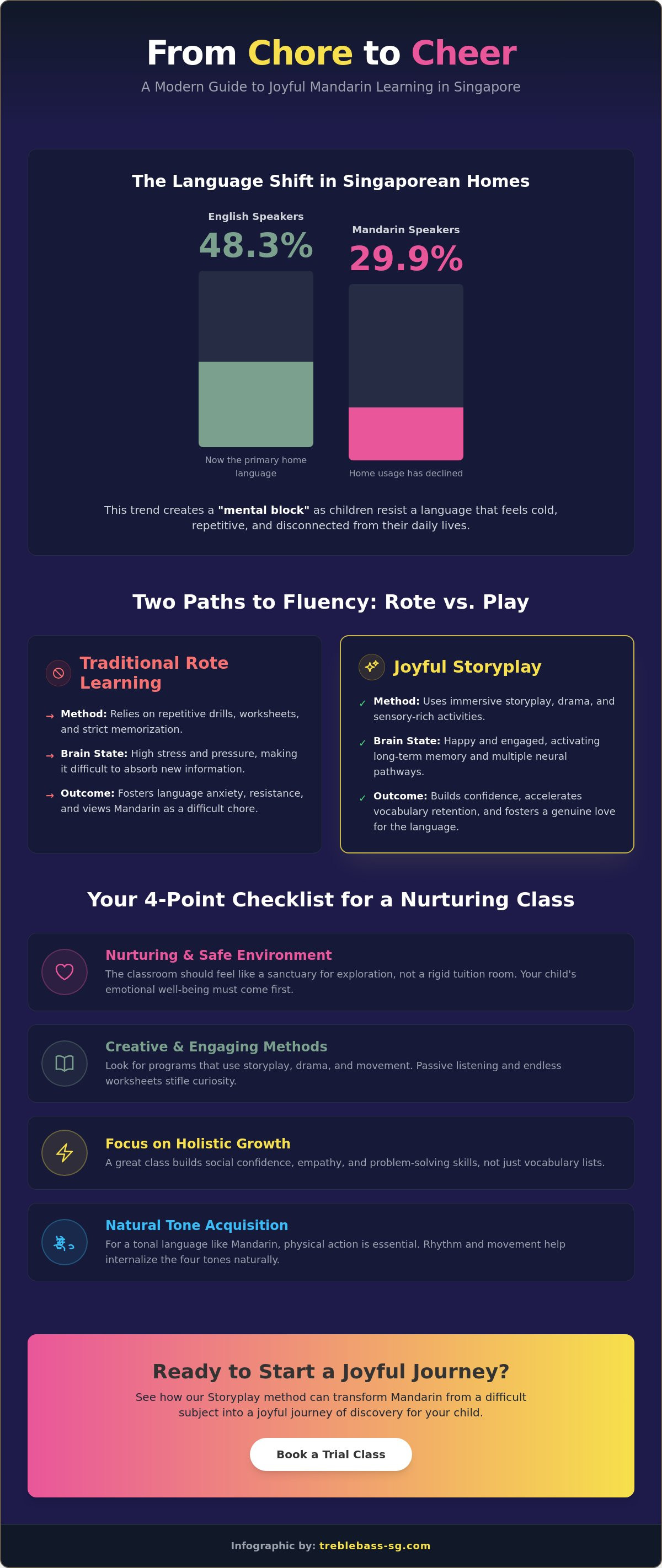
Did you know that English is now the primary language in nearly 48.3% of Singaporean homes, while Mandarin use has dropped to just 29.9%? This shift often leaves parents feeling a quiet sense of worry as they watch their little ones resist speaking the language or feel anxious about future school requirements. Finding a fun Mandarin class for kids Singapore shouldn't feel like another chore on a heavy to-do list. It's difficult to see your child struggle with a subject that feels cold or repetitive, especially when you want them to experience the warmth and vibrancy of their heritage.
We believe that language is a bridge to connection, not a hurdle to clear. In this 2026 nurturing guide, we'll show you how to transform Mandarin from a difficult subject into a joyful journey of discovery. You'll learn how immersive storyplay and drama can cultivate a child who confidently initiates conversations and finds wonder in every new word. We'll explore the best ways to foster holistic growth and build a foundation of fluency that feels as natural as play, ensuring your child blossoms with confidence and heart.
Key Takeaways
Understand why traditional rote learning often backfires and how joyful engagement leads to faster vocabulary growth.
Identify the four non-negotiable qualities of a nurturing environment that values your child's emotional well-being as much as their fluency.
Evaluate different teaching models to select a fun Mandarin class for kids Singapore that sparks curiosity instead of resistance.
See how creative methods like storyplay and drama help children as young as one year old absorb language through their senses.
Get practical tips on preparing for your first trial class and finding a welcoming space near Holland Village or Central Singapore.
Table of Contents
Why "Fun" is the Secret to Mandarin Fluency in Singapore
For many Singaporean families, the evening routine often includes a gentle tug-of-war over Mandarin homework. With nearly half of our households now speaking English as a primary language, children in Gen Alpha often view Mandarin as a clinical subject rather than a living, breathing way to communicate. Traditional rote learning, which relies on repetitive drills and memorization, often backfires by creating a "mental block." When a child feels pressured, their brain enters a state of high stress, making it nearly impossible to absorb new information. Choosing a fun Mandarin class for kids Singapore changes this dynamic entirely. By shifting the focus from "tuition" to "enrichment," we replace the fear of being wrong with the excitement of discovery. This emotional safety is the foundation of fluency.
When a child is happy, their brain is more receptive to learning. Emotional engagement has been shown to significantly accelerate vocabulary retention because the information is processed through the brain's limbic system, which handles emotions and long-term memory. Instead of viewing Mandarin as a series of tests to pass, children begin to see it as a tool for play and connection. This shift reduces "language anxiety," especially in shy children who might otherwise stay silent. In a nurturing environment, the pressure to be perfect fades away, allowing their natural curiosity to take the lead.
The Science of Play-Based Language Learning
Research into second-language acquisition suggests that emotional engagement is a powerful catalyst for memory. When children are immersed in sensory-rich environments, their brains activate multiple neural pathways simultaneously. Our "Storyplay" approach moves vocabulary from short-term memory into long-term retention because the words are attached to a feeling, a texture, or a movement. For a tonal language like Mandarin, rhythm and physical action are essential. When a child jumps or dances while learning a new phrase, the physical "beat" helps them internalize the four tones naturally, without the need for dry, repetitive explanation.
Mandarin as a Tool for Holistic Development
Learning a language should never be an isolated task. It's a transformative tool for a child's entire well-being. Through group dramatic play, even the most reserved children begin to find their voice. They aren't just practicing words; they're building social confidence and learning to collaborate with their peers. By "living" through different characters in Chinese stories, they develop deep empathy and a broader perspective of the world. Beyond communication, the bilingual brain is a powerhouse of executive function. Navigating two languages improves problem-solving skills and mental flexibility, giving your child a cognitive edge that lasts a lifetime. Finding a fun Mandarin class for kids Singapore ensures that this growth happens in a space of warmth and light, where every small success is celebrated.
Choosing the Right Mandarin Class: A Parent’s Evaluation Framework
Selecting a fun Mandarin class for kids Singapore involves looking deeper than just a convenient location or a shiny brochure. It’s about finding a sanctuary where your child feels seen, heard, and celebrated. While many centers focus strictly on academic milestones, a truly nurturing program prioritizes the emotional bond between the child and the language. This connection is what transforms a simple lesson into a lifelong journey of cultural discovery. When a child feels safe and connected, their natural ability to absorb new sounds and concepts increases exponentially.
We believe the environment must speak to a child’s heart before it speaks to their mind. When you visit a potential center, look for signs of "joyful purpose" in every corner. Is the space inviting, warm, and filled with light? A quality classroom shouldn't feel like a clinical setting or a rigid tuition room. Instead, it should be a safe space for exploration where children feel the freedom to take risks with their speech without fear of judgment. This sense of safety is the first non-negotiable factor in any quality enrichment program.
The cognitive benefits of being bilingual are extensive, ranging from improved focus to enhanced executive function. These advantages only truly blossom when the pedagogy allows for creative movement and discovery. If a program relies heavily on passive listening or repetitive worksheets, it risks stifling the very curiosity that drives deep learning. A child's mind is like a garden; it needs the right environment of play and interaction to grow strong and vibrant. You want to see a curriculum that values practice through lived experience rather than just rote memorization.
Curriculum: Storytelling vs. Worksheets
For children under the age of six, interactive storytelling is significantly more effective than repetitive writing or rote memorization. Themed learning provides a rich, real-world context that makes new vocabulary feel relevant and exciting. Look for programs that seamlessly integrate music, dance, and drama to engage the whole child. This multi-sensory approach ensures that Mandarin isn't just a collection of words to be memorized, but a vibrant world of stories they can inhabit and enjoy through their senses.
Teacher Qualifications and Heart
Finding a fun Mandarin class for kids Singapore that resonates with your family requires looking at the teachers' hearts as much as their professional degrees. A nurturing personality is essential for building the trust that allows a child to flourish. We value educators who bring backgrounds in the performing arts, as they understand how to use movement and expression to guide a child's journey. A true "Nurturing Expert" knows how to handle a reluctant child with maternal empathy, using patience to turn hesitation into proud confidence. If you are looking for a place that values this gentle, expert approach, you might explore the nurturing programs at Treble Bass designed to support every child's unique developmental path.
Top Fun Mandarin Classes for Kids in Singapore (2026)
Singapore offers a rich tapestry of educational choices, but finding the right fit for your family means looking beyond the curriculum. Every child responds differently to instruction; some thrive in structured environments, while others need the freedom of a more creative outlet. A fun Mandarin class for kids Singapore should align with your child's unique personality and your own educational philosophy. We've seen a beautiful shift toward arts-integrated learning, where the language isn't just taught as a subject, but experienced as a joyful narrative through movement and emotion. This approach recognizes that children are natural storytellers who learn best when their imaginations are fully engaged.
Teaching styles in the city generally fall into three distinct categories. Academic centers prioritize primary school readiness, focusing heavily on literacy and formal structure. Play-based centers often use high-energy games and friendly competition to keep children engaged and active. Finally, arts-integrated centers use storytelling, music, and drama to build deep, emotional connections with the language. For families with very young children, parent-accompanied sessions are particularly valuable. These sessions allow for a shared bonding experience, creating a bridge between the classroom and home life that reinforces learning in a natural, stress-free way.
Treble Bass: The Nurturing Choice for Storyplay
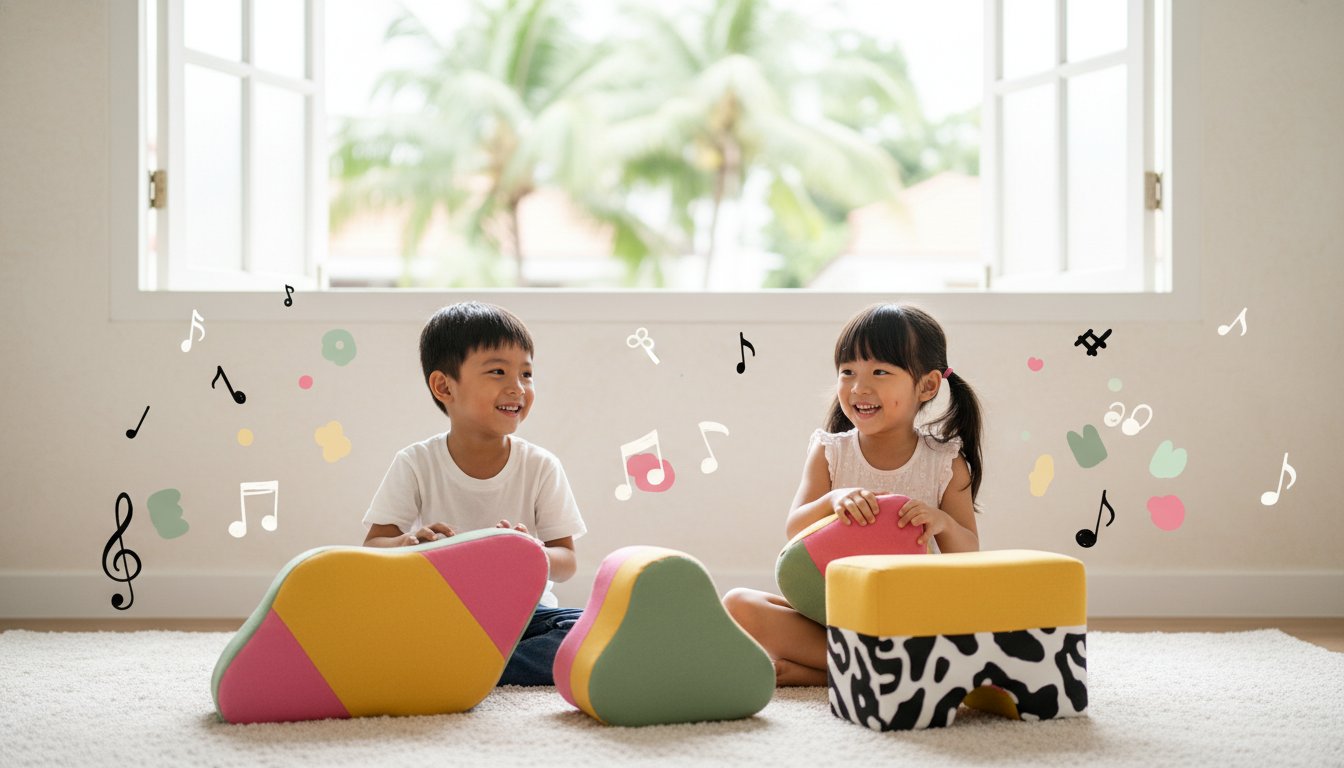
At Treble Bass, we believe wholeheartedly in the power of play to boost early language development. Our philosophy is built on a foundation of "Maternal Empathy," ensuring that our space is the safest harbor for new learners to find their voice. We've carved out a unique "Storyplay" niche in the Singapore market, where language is treated as a living story rather than a list of vocabulary words to memorize. Our Playtots (1-3 years) program offers a gentle, sensory-rich introduction for toddlers, while our Adventurers (3-6 years) Chinese Speech & Drama sessions help older children build confidence through performance. You can discover more about our approach in our guide on Playtots: Best Chinese Storyplay for Toddlers in Singapore.
Other Notable Centers in Singapore
While we focus on the magic of storyplay, other centers offer different strengths depending on your child's goals. Chengzhu Mandarin Centre is well-regarded for its intensive drama-based immersion, which encourages children to use expressive speech in a theatrical setting. If your family is beginning to focus on the transition toward formal primary education, Hua Language Centre provides a structured environment that builds a strong academic foundation. For children who possess endless energy and love a fast-paced environment, EduGrove is a popular fun Mandarin class for kids Singapore known for its high-energy, improvisational games. Each of these centers contributes to a vibrant community where every child's journey can be supported with care and expertise.
The Magic of Storyplay: Why Treble Bass is the Top Choice
At Treble Bass, we don't just teach a language; we cultivate a sanctuary where every child feels empowered to explore their potential. Our philosophy blends high-level professional expertise with a deep sense of maternal empathy. We believe that a fun Mandarin class for kids Singapore should be a space of light, movement, and discovery. By treating Mandarin as a transformative tool for holistic development, we move beyond the rigid structures of traditional instruction. This approach allows children to connect with the language on a profound emotional level, ensuring that their learning journey is filled with a sense of joyful purpose from their very first session.
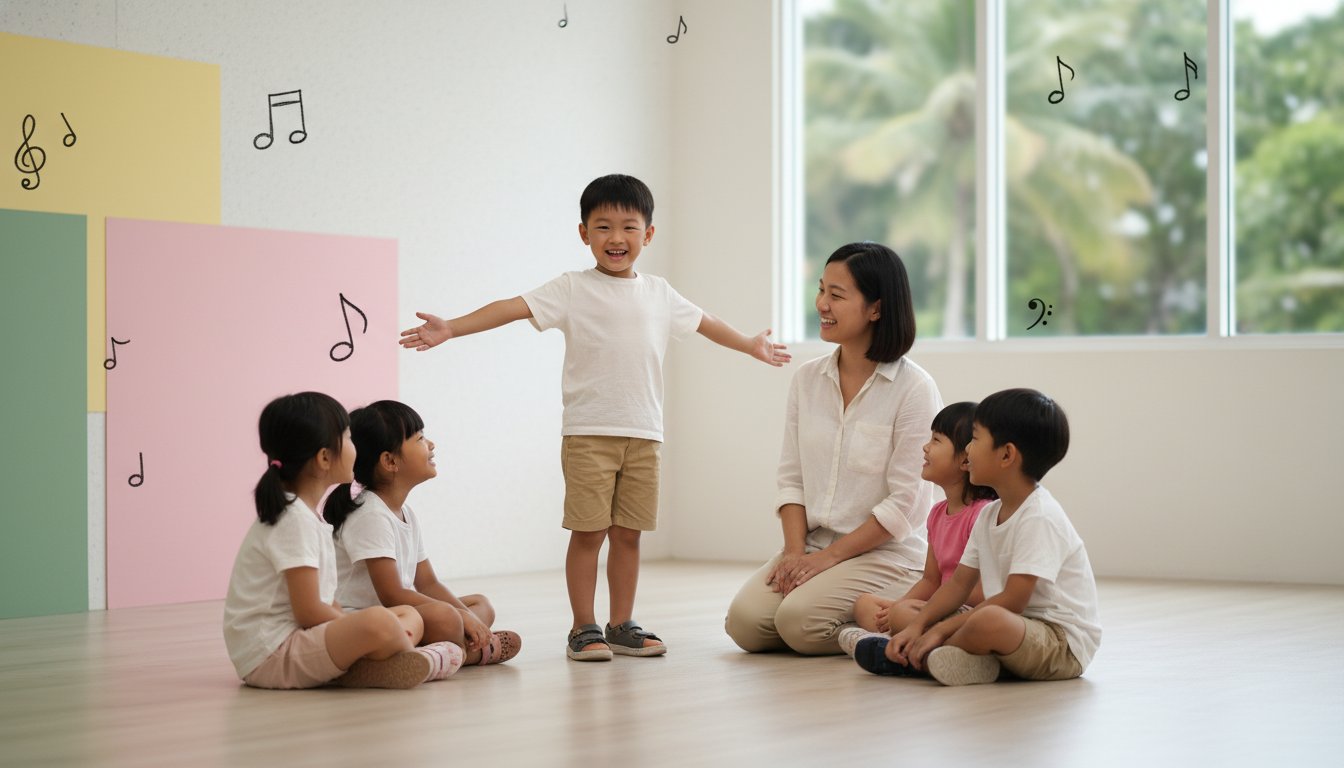
Our proprietary programs are carefully designed to meet children exactly where they are in their developmental journey. For our youngest learners, the Playtots Chinese storyplay sessions for 1 to 3 year olds offer a sensory-rich introduction. They absorb the sounds and rhythms of Mandarin through immersive stories that engage their sight, touch, and hearing. As they grow, they transition into our Adventurers Chinese Speech & Drama program for 3 to 6 year olds. Here, we focus on building leaders. By stepping into different characters and performing on our internal stage, children develop the public speaking confidence they'll carry with them for a lifetime.
We've observed that physical movement acts as a powerful catalyst for cognitive growth. This is why our Starsteps Themed Dance sessions often complement our language programs. When a child connects a specific gesture or dance move to a Mandarin phrase, the language becomes etched into their muscle memory. This multi-sensory connection accelerates retention and makes the learning process feel like a natural extension of play. It's about creating a lived experience where the child isn't just reciting words, but "feeling" the language through their whole body, which is what makes us a truly fun Mandarin class for kids Singapore.
Nurturing the "Whole Child"
Our mission extends far beyond just expanding a child's vocabulary. We focus on the "whole child," valuing empathy, resilience, and self-assurance as much as technical proficiency. Every lesson plan is infused with "Joyful Purpose," ensuring that even the most technical aspects of speech are presented as exciting challenges. This nurturing approach helps children see themselves as capable communicators who can navigate the world with heart. You can read more about how we foster these traits in our Confidence on Every Stage: A Nurturing Guide to Speech and Drama.
Proprietary Programs: Playtots & Adventurers
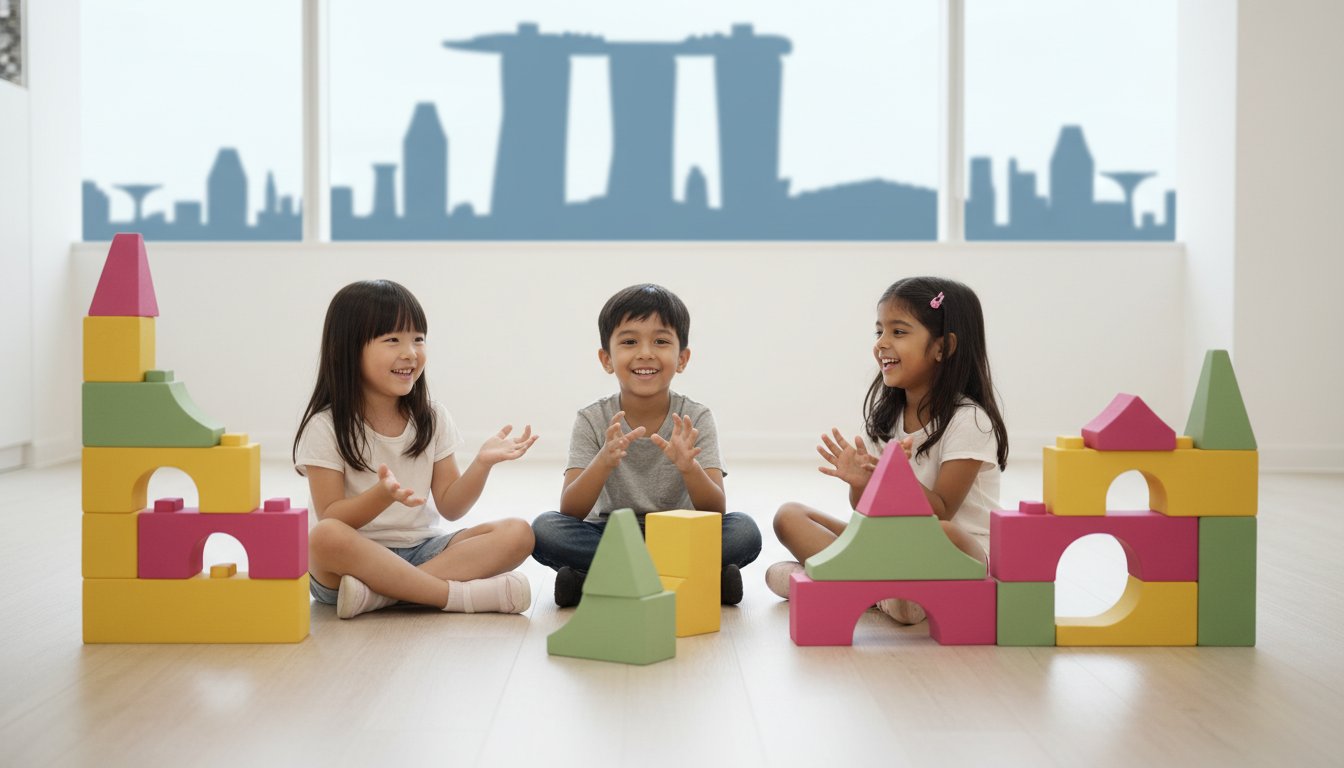
A day in our programs might begin with a whimsical story that transports children to a world of imagination, followed by creative movement that brings the narrative to life. These experiences bridge the gap between English and Mandarin speakers by using universal themes of friendship and wonder. We also place a strong emphasis on the "Bonding Factor." By involving families in the journey, we facilitate meaningful connections that strengthen the parent-child relationship. If you're ready to see your child flourish in a safe and vibrant environment, we invite you to discover our nurturing programs at Treble Bass today.
Getting Started: From Trial Classes to Bilingual Success
Embarking on a bilingual journey is one of the most beautiful gifts you can offer your child. It begins with a single, gentle step: the trial session. To prepare your little one for their first fun Mandarin class for kids Singapore, it's best to keep the atmosphere light and expectant. Avoid framing the visit as a "lesson" or a "test." Instead, talk about the new friends they'll meet and the stories they'll discover together. When a child enters a new space feeling curious rather than pressured, their heart opens up to the language naturally. We've found that children who arrive with a sense of wonder are far more likely to engage with the sensory elements of our programs.
The transition from playful exploration to genuine proficiency is a gradual, rewarding process. Over a three-year journey, we watch children move from the sensory-led wonder of toddlerhood into the confident self-expression of early childhood. This progression isn't about hitting rigid academic markers; it's about the steady cultivation of a child's internal voice. By the time they reach the primary years, the goal is for them to not only understand Mandarin but to feel a sense of ownership over it. Supporting this growth at home can be as simple as playing Chinese songs during car rides or reading a familiar storybook in Mandarin before bed, creating a seamless bridge between the classroom and home life.
The Holland Village Advantage
Located in the vibrant heart of the city, Treble Bass serves as a central hub for families seeking a fun Mandarin class for kids Singapore. Our boutique center in Holland Village offers a warm, community-oriented feel that larger institutions often lack. We understand that busy parents in Central Singapore value both convenience and quality. Our scheduling is designed to fit into your family's rhythm, making it easier to prioritize these transformative experiences. In our safe and inviting space, you'll find a community of like-minded parents and mentors who are all dedicated to the holistic well-being of every child. This proximity allows for a more personal connection, where every family is known by name.
Your Next Steps to Joyful Mandarin
When you attend a trial session, take a moment to observe the interaction between the teacher and the children. Look for that spark of "joyful purpose" and the presence of maternal empathy. You might ask the teachers how they encourage a child who is feeling shy, or how they integrate movement into their storytelling. These conversations help build a foundation of trust between your family and our mentors. We're here to guide you through every stage of this exciting journey, ensuring that your child's path to bilingualism is paved with confidence and delight. We invite you to Book a Playtots or Adventurers Trial at Treble Bass Today! and begin this wonderful adventure together.
Your Child’s Path to Bilingual Confidence Starts Today
Transforming Mandarin from a source of stress into a spark of joy is a gift that will serve your child for years to come. We've explored how moving away from rigid instruction toward immersive storytelling and creative movement allows children to find their own voices naturally. By choosing a nurturing environment that values emotional connection, you're doing more than teaching a language; you're fostering holistic growth and self-assurance. This shift in perspective ensures that every word learned is a building block for their internal confidence.
Since 2015, we've dedicated ourselves to this mission at our convenient Holland Village location. Whether your little one is exploring their first words in our Playtots sessions or building public speaking leadership in our Adventurers program, we provide the safest space for discovery. Finding the right fun Mandarin class for kids Singapore is the first step toward a future where your child speaks with heart and pride. We invite you to Book a Joyful Mandarin Trial Class at Treble Bass and watch your child's potential blossom in a world of story and play. The journey toward bilingual success is one we're honored to share with your family.
Frequently Asked Questions
What is the best age to start a Mandarin class for my child in Singapore?
Early childhood is the ideal window for language acquisition because the brain is most receptive to new sounds and rhythms. At Treble Bass, we welcome children as young as one year old into our Playtots Chinese storyplay sessions. Starting at this age allows them to absorb tonal nuances naturally through sensory exploration, building a foundation of comfort that makes future learning feel like a joyful extension of play.
How is storyplay different from traditional Mandarin tuition?
Storyplay focuses on emotional engagement and lived experience rather than rote memorization or repetitive worksheets. While traditional tuition often prioritizes academic drills, a fun Mandarin class for kids Singapore like ours uses narrative, music, and drama to spark curiosity. This approach ensures that children aren't just reciting words; they're actively participating in a vibrant story that makes the language feel alive and relevant to their world.
My child doesn’t speak any Mandarin at home; will they be able to follow the class?
Yes, our programs are specifically designed to be inclusive for children from English-speaking households. We use visual cues, expressive gestures, and rhythmic patterns to ensure every child understands the context of the lesson. This immersive yet gentle environment helps bridge the gap between languages, allowing your child to build confidence even if they've had little prior exposure to Mandarin at home.
Are the teachers at Treble Bass native Mandarin speakers?
Our team consists of highly qualified educators who possess a deep mastery of the Mandarin language and a passion for early childhood development. They bring a wealth of professional expertise and artistic background to every session. This ensures your child is exposed to accurate pronunciation and cultural nuances in a way that's both authoritative and deeply nurturing, creating a safe harbor for their linguistic growth.
What are the benefits of Chinese Speech and Drama for a shy child?
Chinese Speech and Drama provides a safe stage for shy children to discover their internal voice without pressure. By stepping into different characters in our Adventurers program, children can express themselves through a creative persona. This distance allows them to take risks with their speech and build social confidence, eventually leading to a more self-assured presence both in and out of the classroom.
How long are the sessions and do I need to accompany my child?
Sessions typically run for 45 to 60 minutes depending on the specific age group and program. For our youngest learners in Playtots, we encourage parent-accompanied sessions to facilitate meaningful bonding and ensure the child feels secure. As they transition into the Adventurers classes for older children, they begin to attend independently, which helps foster a sense of autonomy and personal accomplishment in their journey.
Can my child switch between English and Mandarin programs at Treble Bass?
We offer the flexibility to explore both our English and Mandarin enrichment tracks to support your child's holistic development. Whether they're enrolled in Bubbles English storyplay or our fun Mandarin class for kids Singapore, the core philosophy of nurturing expertise remains the same. You can speak with our team to find the best balance of sessions, such as combining Starsteps Themed Dance with a language program.
What is the teacher-to-student ratio in a typical fun Mandarin class?
We maintain small class sizes to ensure every child receives the individual attention and maternal empathy they deserve. A typical ratio in our boutique Holland Village center is kept low, usually around one teacher to six or eight students. This intimate setting allows our mentors to tailor their approach to each child's unique developmental path, ensuring every small success is celebrated and supported with care.
Comments