_edited.jpg)
Chinese Enrichment for 2 Year Olds in Singapore: A Nurturing Buying Guide for 2026
What if the secret to your child’s bilingual future isn't found in a textbook, but within the pages of a magical storybook? For many parents looking for Chinese enrichment for 2 year old Singapore, the fear is often the same; you don't want to trade your toddler's precious sense of wonder for a high-pressure academic environment. It's completely natural to feel a bit lost when your little one refuses to speak Mandarin at home or hides behind your legs at the mention of a classroom. We understand that at this tender age, language isn't just a skill to be drilled; it's a world to be inhabited through the magic of story and play.
You deserve to find a space where your child feels safe to explore and confident to speak. This guide will help you navigate the different methodologies available in 2026, showing you how to choose an environment that prioritizes joyful discovery over rote memorization. You'll discover how to select a program that sparks a lifelong love for Mandarin through immersive experiences. We'll look at why programs like Playtots Chinese storyplay are so effective during this early developmental window, helping your child find their voice through bilingual play and meaningful connection.
Key Takeaways
Learn why age two is a pivotal transition for language, where passive listening blossoms into active verbal expression.
Understand the differences between rigid academic settings and nurturing Chinese enrichment for 2 year old Singapore that uses storyplay to build confidence.
Discover the essential checklist for choosing a center, focusing on teacher-to-student ratios and early childhood pedagogy that supports holistic growth.
Get practical tips for managing your toddler’s first trial class, ensuring a smooth and tear-free transition into their new bilingual environment.
Explore how a blend of speech, drama, and sensory exploration transforms Mandarin from a lesson into a joyful, lived experience for your little one.
Table of Contents
Why Age 2 is the Golden Window for Chinese Enrichment in Singapore
Choosing the Right Format: Playgroup vs. Storyplay vs. Academic Chinese
Evaluation Checklist: What to Look for in a Chinese Enrichment Center
Preparing Your Toddler (and Yourself) for Their First Mandarin Class
Why Playtots at Treble Bass is the Heart of Chinese Enrichment
Why Age 2 is the Golden Window for Chinese Enrichment in Singapore
At age two, a child's brain is like a garden in full bloom, ready to soak up every sound and nuance. This is precisely why Chinese enrichment for 2 year old Singapore is so transformative. During this stage, children possess an incredible capacity for second-language acquisition, as their neural pathways are still remarkably flexible. They aren't just memorizing words; they're absorbing the very essence of the language's melody, rhythm, and structure. This is the magic of the early years. It's a time when learning happens through osmosis rather than effort.
This period marks a beautiful shift from passive observation to active expression. Your toddler has spent months listening, and now they're eager to participate. By providing a nurturing space at this specific age, we help them bridge the gap between understanding and speaking. When the environment is filled with laughter and curiosity, the language becomes a tool for joy rather than a chore to be completed. We've seen how this early exposure builds a deep, internal comfort with the language that lasts a lifetime.
The Neurological Advantage of Early Bilingualism
Bilingualism does more than just add a second vocabulary; it actually strengthens the brain's executive function. This cognitive workout helps toddlers develop better focus and problem-solving skills as they grow. The window for achieving a native-like accent is wide open right now, especially when we incorporate rhythm and tone. Our music classes for toddlers demonstrate how melodic patterns support the distinct phonetics of Mandarin. These rhythmic experiences make those tricky four tones feel like a natural part of a song.
Social and Emotional Growth Through Group Play
Two-year-olds are beginning to move beyond parallel play, where they play beside others, into interactive play, where they play with them. In a group setting focused on Chinese enrichment for 2 year old Singapore, this transition happens within a supportive, bilingual community. Sharing a story or a puppet show encourages them to listen with empathy and respond with confidence. These shared moments build a sense of belonging. They make the language a bridge to making new friends and discovering the world together.
Choosing an immersive, joyful approach now prevents the language resistance that often surfaces in later years. When a child associates Mandarin with stories, play, and warm connections, they don't see it as a subject. It simply becomes the language of their favorite adventures. By cultivating this love early, you're giving them a gift that supports their holistic development. They grow up feeling that Chinese is a part of who they are, not just something they do.
Choosing the Right Format: Playgroup vs. Storyplay vs. Academic Chinese
Searching for Chinese enrichment for 2 year old Singapore often reveals three distinct paths: the traditional academic approach, the generic playgroup, and the immersive Storyplay method. Academic classes typically lean on flashcards and repetition. While these might seem productive to the adult eye, they often fail to capture a toddler's heart. Generic playgroups offer social time but might lack a structured linguistic focus. Storyplay, however, weaves the language into a narrative tapestry. It allows your child to live the language through characters and adventures. This approach respects the toddler's need for movement and imagination, making the learning process feel like a natural extension of their play.
Every child is a unique blossom with their own pace of growth. Some toddlers are bold explorers, while others are gentle observers who need time to warm up. The benefits of bilingualism are most profound when the language is tied to positive emotional experiences. When a child pretends to be a hungry caterpillar or a brave explorer in Mandarin, the vocabulary sticks because it's attached to a feeling. This is why we advocate for methods that prioritize creative expression over rigid perfection. Matching the enrichment format to your child’s personality ensures they don't just learn Chinese; they learn to love it.
Rote Learning vs. Creative Immersion
Instead of the "memorize and repeat" method, creative immersion focuses on "experience and express." Drama and role-play are powerful tools because they place words in a meaningful context. By acting out a scene, a child uses their whole body to anchor new sounds. This physical involvement helps cement vocabulary in long-term memory far more effectively than looking at a card. If you're curious about how this creative spark evolves as they grow, our guide on speech and drama class Singapore explores the long-term impact of artistic expression on a child's confidence.
The Importance of Parent-Accompanied Sessions for 2-Year-Olds
At age two, your presence provides the "secure base" your child needs to take linguistic risks. Parent-accompanied sessions aren't just about supervision; they're about shared discovery. When you learn the songs and cues alongside your child, it becomes easy to sprinkle Mandarin into your daily routines at home. This consistency bridges the gap between the classroom and the living room. You'll know your child is ready for an independent Adventurers style class when they start leading the way into the room with a curious smile and a sense of belonging.
Finding the right fit is a journey of empathy and observation. When the environment feels safe and the activities are joyful, your child's potential can truly flourish. If you're ready to see your little one thrive through the magic of narrative, exploring our Playtots Chinese storyplay program can be a wonderful first step in their bilingual journey.
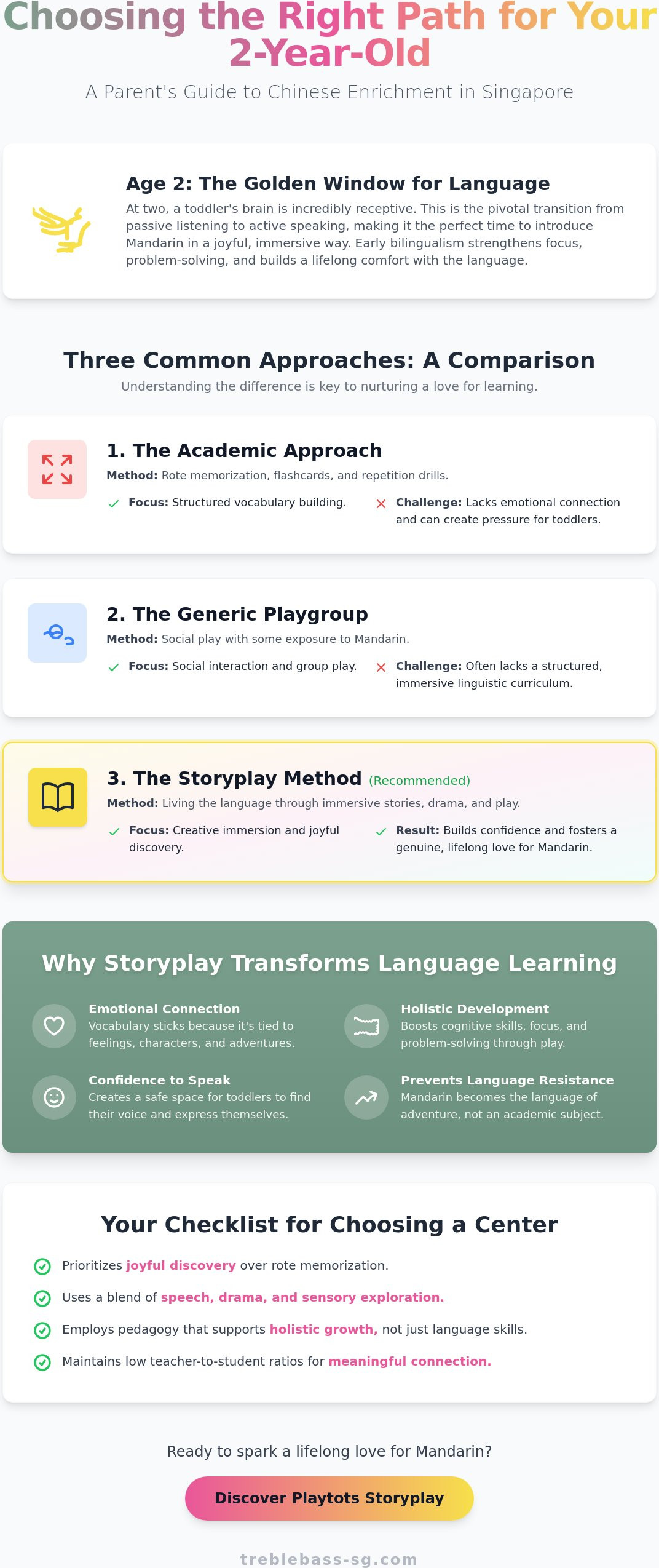
Evaluation Checklist: What to Look for in a Chinese Enrichment Center
Selecting the right space for Chinese enrichment for 2 year old Singapore requires looking beyond the shiny brochures and registration fees. At this age, the environment is the curriculum. You want to find a place that feels like a second home, where the air is filled with what we call joyful purpose. This isn't just about fun; it's about intentional activities that spark cognitive growth through play. A critical starting point is the teacher-to-student ratio. For a two-year-old, a small group isn't just a luxury. It's a necessity for safety and personalized attention. When a teacher can look every child in the eye and respond to their unique cues, the child feels seen and secure enough to experiment with new Mandarin sounds.
Teacher qualifications should go far deeper than simple language fluency. While being a native speaker is helpful, a deep understanding of early childhood pedagogy is what truly transforms a lesson into a developmental milestone. Look for educators who understand how a toddler’s brain processes information. They should be able to explain the why behind their methods, connecting a simple song to phonological awareness or a group game to social-emotional regulation. The curriculum itself should feel relevant to your child’s daily life. Themes involving family, favorite foods, or a trip to the playground help toddlers see Mandarin as a living language that belongs in their world.
The Physical and Sensory Environment
A nurturing classroom should be a feast for the senses. Evaluate how the center uses tactile props, whimsical puppets, and varied sensory materials to bring stories to life. These tools aren't just toys; they're essential bridges to understanding. Much like the creative movement found in dance classes for kids, incorporating movement and rhythm into language lessons significantly boosts retention. When a child jumps like a frog while saying the word in Mandarin, the physical action anchors the linguistic concept in their developing brain. Ensure the space is clean, safe, and thoughtfully designed to encourage exploration.
Teacher Interaction and Nurturing Style
Observe the teachers during a trial session to see how they manage big emotions. Two-year-olds are still learning to navigate their feelings, and a nurturing expert will handle a tantrum with maternal empathy rather than frustration. They should possess the patience to guide a shy child into the group without any sense of pressure. This delicate balance of professional authority and gentle encouragement creates a safe harbor for learning. When a teacher celebrates a child's small attempts at speech, it builds the confidence necessary for them to eventually speak Mandarin with pride and joy. This nurturing style is the heart of effective Chinese enrichment for 2 year old Singapore, ensuring your child feels loved as they learn.
Preparing Your Toddler (and Yourself) for Their First Mandarin Class
It's the morning of the first trial, and you might feel a mix of excitement and nervous energy. That's perfectly okay. When starting Chinese enrichment for 2 year old Singapore, many parents expect their child to start chatting in Mandarin immediately. However, it's very common for a toddler to be observant and quiet for the first few weeks. This is known as the "Silent Period" in early language acquisition. During this time, your child isn't just sitting there; they're building a massive internal library of sounds and meanings. They're absorbing the melody of the language before they feel brave enough to use it. Be patient with their process.
Preparation begins long before you step into the classroom. Talk about the upcoming adventure with a sense of wonder. Use simple, positive language to describe the teachers, the other children, and the fun stories they'll hear. On the day of the trial, ensure your little one is well-rested and has had a light snack. A comfortable child is a curious child. Your role is to be their emotional anchor, providing a steady presence that allows them to explore this new linguistic landscape at their own pace.
Tackling Separation Anxiety and New Environments
Moving from the comfort of home to a classroom can trigger big feelings. If you're transitioning to an independent class, a consistent goodbye ritual is your best friend. A quick hug, a specific phrase, and a reassuring smile tell your child that you'll be back. At home, you can use puppets or storybooks to act out what happens in class. When you model enthusiasm for Mandarin, your child sees it as something safe and exciting. Your confidence becomes their confidence, helping them feel secure in their new bilingual community.
Home Reinforcement Strategies for English-Speaking Families
You don't need to be a fluent speaker to support your child’s journey. Focus on meaningful connections rather than perfect grammar. If they learn a song about a little bird in class, hum the tune while you're getting dressed in the morning. This simple act bridges the gap between school and home. Building bilingual confidence is a holistic process. Many families find that our English storyplay and drama classes complement their Mandarin journey by strengthening their child's overall expressive skills and social confidence.
The goal isn't to be a teacher at home, but to be a partner in discovery. Keep the atmosphere light and whimsical. If you're ready to see how your child responds to a world of story and song, we invite you to book a trial session for Playtots Chinese storyplay and begin this beautiful adventure together.
Why Playtots at Treble Bass is the Heart of Chinese Enrichment
At Treble Bass, we believe that the most profound learning happens when a child's heart is as engaged as their mind. Our approach to Chinese enrichment for 2 year old Singapore is rooted in the philosophy of Storyplay. It's a method that honors the whimsy of early childhood while grounding every activity in sound pedagogical principles. We don't just teach a language; we cultivate an environment where Mandarin feels like a warm embrace. This is where your child's bilingual journey transforms from a scheduled lesson into a cherished part of their developmental story. By focusing on the whole child, we ensure that their first steps into a second language are filled with light and discovery.
Our team consists of passionate mentors who bring a maternal touch to their professional expertise. These Nurturing Experts understand that a two-year-old’s progress isn't measured by a checklist of vocabulary words. Instead, we value the unique journey of each child. We celebrate the first time a shy toddler reaches out to touch a puppet or the moment they confidently mimic a Mandarin phrase during a game. This focus on internal growth over rigid milestones ensures that every child feels safe to flourish at their own natural pace. This sense of safety is the foundation upon which all future academic success is built.
A Peek Inside a Playtots Chinese Storyplay Session
Every session is a carefully choreographed flow of discovery designed for the toddler's specific developmental needs. We start with musical bonding, where rhythm and song create a sense of collective belonging and prepare the brain for linguistic input. Then, we dive into the heart of the theme using whimsical puppets and child-focused imagery. If the story is about a garden, the children don't just see pictures; they feel the leaves, hear the rain, and move like butterflies. This sensory exploration creates a lived experience that makes the language tangible. By the time the session ends, the children haven't just heard Mandarin; they've played in it.
From Playtots to Adventurers: A Long-term Language Journey
The magic doesn't stop when your child turns three. As they grow, our curriculum evolves to meet their expanding curiosity and social skills. The foundational love for story developed in Playtots naturally transitions into our Adventurers Chinese Speech & Drama program for three to six-year-olds. This continuity builds a strong community of joyful, bilingual learners who carry their confidence into their formal schooling years. We are committed to being a lifelong partner in your child's holistic development, fostering empathy and creativity alongside linguistic proficiency. Your child's potential is limitless when it's nurtured in a space of love and expertise.
Are you ready to see your little one's eyes light up as they discover the wonders of a new language? We invite you to experience our nurturing environment firsthand and become part of our vibrant community. Join a Playtots trial and see the magic of Mandarin Storyplay for yourself!
Embarking on a Joyful Bilingual Adventure Together
Choosing the right path for your child’s language development is a journey of the heart. You've learned how the golden window of age two allows for natural acquisition and why immersive Storyplay far outweighs the stress of rote learning. By prioritizing a nurturing environment with small teacher-to-student ratios, you ensure your child feels safe to explore every new sound with confidence. Finding a space that values the child's unique journey over rigid milestones is the key to sparking a lifelong love for Mandarin.
At Treble Bass, we've spent over a decade nurturing young hearts since our founding in 2015. Our proprietary Playtots and Adventurers curriculum is delivered by highly qualified teachers with specialized expertise in early childhood drama and music. This combination of professional wisdom and maternal empathy makes our program a standout choice for Chinese enrichment for 2 year old Singapore. We invite you to see the magic of our classroom firsthand and discover how we transform language into a lived experience. Book a Playtots Chinese Storyplay Trial Today and let's nurture your child's potential together in a space of light and discovery.
Frequently Asked Questions
Is my 2-year-old too young for Chinese enrichment classes?
No, age two is actually the perfect time to start because a child's brain is highly receptive to new sounds and tones. This developmental stage is characterized by rapid neural growth, making it easier for them to absorb Mandarin naturally through play and song. Starting early prevents future resistance and helps them view the language as a joyful part of their daily life rather than a school subject.
My child doesn’t speak any Mandarin. Will they feel lost in an immersion class?
Your child won't feel lost because our nurturing experts use puppets, music, and sensory props to bridge the communication gap. Immersion at this age relies on "comprehensible input," where children understand the context through actions and visuals before they know every word. It's a safe and gentle way to build a foundation for Chinese enrichment for 2 year old Singapore without any pressure to perform.
What is the difference between a Mandarin playgroup and Storyplay?
While a standard playgroup focuses on general social interaction, Storyplay is a narrative-driven method that weaves Mandarin into an imaginative adventure. In a Storyplay session, every song and activity is connected to a central tale, making the language meaningful and memorable. This approach respects the toddler's need for movement and creativity, transforming a simple lesson into a "lived experience" that sticks in their long-term memory.
How long does it take for a toddler to start speaking Mandarin?
Every child follows their own unique timeline, but many toddlers undergo a "Silent Period" for several weeks or months where they listen intently before speaking. You might notice them humming class songs or identifying objects at home before they use full phrases in the classroom. Consistency is key; as their confidence grows through regular exposure, their verbal expression will naturally blossom in its own time.
Should I choose a parent-accompanied or independent class for my 2-year-old?
Most 2-year-olds benefit from parent-accompanied classes like our Playtots sessions because your presence provides a "secure base" for exploration. It also allows you to learn the songs and cues to reinforce at home. However, if your child is already comfortable in social settings and shows signs of independence, they might be ready to transition into a more independent format as they approach age three.
How do I know if a Chinese enrichment center is right for my child after a trial?
Trust your intuition by observing your child's emotional state during and after the session. A right fit is a center where the environment feels warm and the teacher handles "big emotions" with maternal empathy. If your little one was curious, felt safe to explore, or even just watched with quiet interest, it's a sign that the nurturing atmosphere is working to build their confidence.
Can Chinese enrichment help with my child’s overall speech development?
Yes, engaging in Chinese enrichment for 2 year old Singapore can significantly boost overall communication skills. The use of drama, rhythmic chanting, and vocal play encourages toddlers to experiment with different sounds and mouth movements. These activities strengthen the muscles used for speech and improve active listening skills, which benefits their development in both Mandarin and English as they learn to express themselves more clearly.
What should we bring to a toddler Chinese class in Singapore?
We recommend bringing a water bottle, a small snack for after class, and a spare change of clothes just in case of messy sensory play. Most centers in Singapore require toddlers and parents to wear grippy socks for safety on the play mats. Bringing a favorite small toy can also help a shy child feel more secure as they transition into the new, whimsical world of the classroom.


Comments