_edited.jpg)
Choosing an Asia Music School in Singapore: A Parents’ FAQ for 2026
What if your child’s first notes weren't about passing a Grade 1 exam, but about finding a voice that sparks a lifelong love for learning? Many parents in Singapore feel the weight of expectation, worrying that a rigid, high-pressure environment might dim their child’s natural curiosity before it has a chance to shine. When searching for the right asia music school in 2026, the choice often feels like a stressful tug-of-war between strict discipline and aimless play. You want your little one to develop kinesthetic learning skills and auditory patterns, but you also want to see them swaying with joy and laughing through every lesson.
We believe that music is a transformative tool for holistic development, not just a skill to be drilled. This guide provides the clarity you need to choose a nurturing environment where your child feels safe to explore their creative potential. You’ll discover how our StoryPlay Adventures and bilingual English-Mandarin programs accelerate language acquisition through meaningful connection and playful discovery. We will break down the differences between creative play and formal exams, ensuring you feel confident in fostering a fertile musical learning environment where your child’s little sparks can truly blossom into a bright, confident future.
Key Takeaways
Learn why a premier asia music school experience in Singapore must bridge the gap between technical skill and cultural literacy to truly inspire your child.
Discover how a play-based, fertile musical learning environment fosters brain development and language acquisition more effectively than traditional rote learning.
Compare traditional instruction with StoryPlay Adventures to see how group discovery builds essential social motor skills in early childhood.
Gain a simple two-step framework for observing your child’s "Little Sparks" to ensure their music school journey remains joyful rather than pressured.
Understand the value of a holistic curriculum that nurtures your child from the inside out, creating lasting family bonds through the magic of music.
Table of Contents What defines a quality Asia music school experience in Singapore? Why holistic music education beats early instrument exams Traditional music schools vs. storyplay-based enrichment How to choose the right school for your child’s learning style Treble Bass: Nurturing the little sparks of Singapore
What defines a quality Asia music school experience in Singapore?
While many institutions measure success by the number of ABRSM certificates displayed on their walls, a truly nurturing asia music school looks for the light in a child's eyes. In 2026, the educational landscape is shifting. Parents aren't just looking for technical proficiency or rote memorisation. They want a space that bridges the gap between creative expression and cultural literacy. It's about finding those "little sparks" of curiosity in infants and toddlers and fanning them into a lifelong flame. Finding a music school near me shouldn't just be about the shortest commute; it should be about finding a community that feels like a second home.
Quality education in Singapore is often synonymous with high pressure. However, a high-quality music experience should offer a fertile environment where a child feels safe to experiment. It's about the deep, meaningful connection between the teacher and the student. When a teacher acts as a passionate mentor, they don't just teach notes; they spark joy. This nurturing approach builds confidence from the inside out, which is far more valuable than any trophy. A quality experience includes:
Teachers who prioritize empathy and patience over rigid, stressful instruction.
Curriculums that adapt to a child's unique learning pace and personality.
Classrooms designed for movement, swaying, and sensory exploration.
A focus on the collective joy of making music together as a family.
The role of central Singapore music hubs
Proximity to vibrant areas like Holland Village matters deeply for busy Singapore parents. A central location saves precious time, but it also influences the energy of the music studio. When a school is nestled in a creative hub, the atmosphere becomes one of shared discovery rather than isolated study. These hubs allow families to connect easily after class, turning a weekly lesson into a moment of social bonding. It’s common to see parents sharing a coffee while their children talk about the "StoryPlay" adventure they just experienced, strengthening the community feel that is so vital for early development.
Beyond the piano: Holistic musical environments
Instrument-only schools often miss the mark for children under six. Early childhood is a time for sensory-rich exploration, not just sitting still on a piano bench. At this age, music is a powerful tool for early language acquisition and brain development. A holistic environment uses auditory patterns and kinesthetic learning to engage the whole child. We focus on the "how" of discovery rather than just the "what" of the instrument. This ensures that music becomes a natural, lived experience for your child, accelerating their cognitive growth while they simply think they're playing.
Why holistic music education beats early instrument exams
Early childhood isn't a race to a certificate; it’s a precious window to cultivate a fertile musical learning environment where play is the primary work. While some parents might search for an asia music school that pushes for Grade 1 exams by age five, forcing technical scales too early can dim a child's natural curiosity. Research in neuroplasticity shows that rhythm and movement accelerate brain development significantly faster than rote memorisation. When a toddler sways to a complex beat, they're building the neural foundations for mathematical logic and physical coordination. We believe in building confidence through dramatic play and storytelling long before we introduce the pressure of a metronome.
This approach transforms music from a chore into a transformative tool for growth. By focusing on the "how" of discovery, we ensure children develop a deep, emotional connection to sound. This foundation makes future instrument mastery feel like a natural evolution rather than a forced habit. You can find more details on these developmental milestones in our guide to the best music classes for toddlers in Singapore.
The science of rhythm and language acquisition
Auditory patterns found in music mirror the tonal inflections of Mandarin, making music a powerful catalyst for language acquisition. For toddlers aged 1 to 3, our bilingual storyplay adventures turn linguistic hurdles into joyful songs. Kinesthetic learning is the heartbeat of this process. It’s been observed that preschoolers who engage in physical movement while learning language show a 25% increase in vocabulary retention over a six month period. By swaying and tapping to the beat, children absorb the rhythm of speech, making their journey into bilingualism feel effortless and fun.
Fostering confidence through speech and drama
Confidence is a "little spark" that needs a safe space to grow. Many music schools focus solely on the fingers, but we look at the whole child. Integrating speech and drama helps even the most hesitant children find their voice and speak up with clarity. The transition from our "Baby C" sensory play to the "Adventurers" drama program allows children to explore different personas in a protective environment. Learning to "shine" on stage is more than a performance skill; it's a life skill that fosters empathy and resilience. If you're looking for a place that values your child's unique journey, consider visiting our Holland Village studio to see these meaningful connections in action.
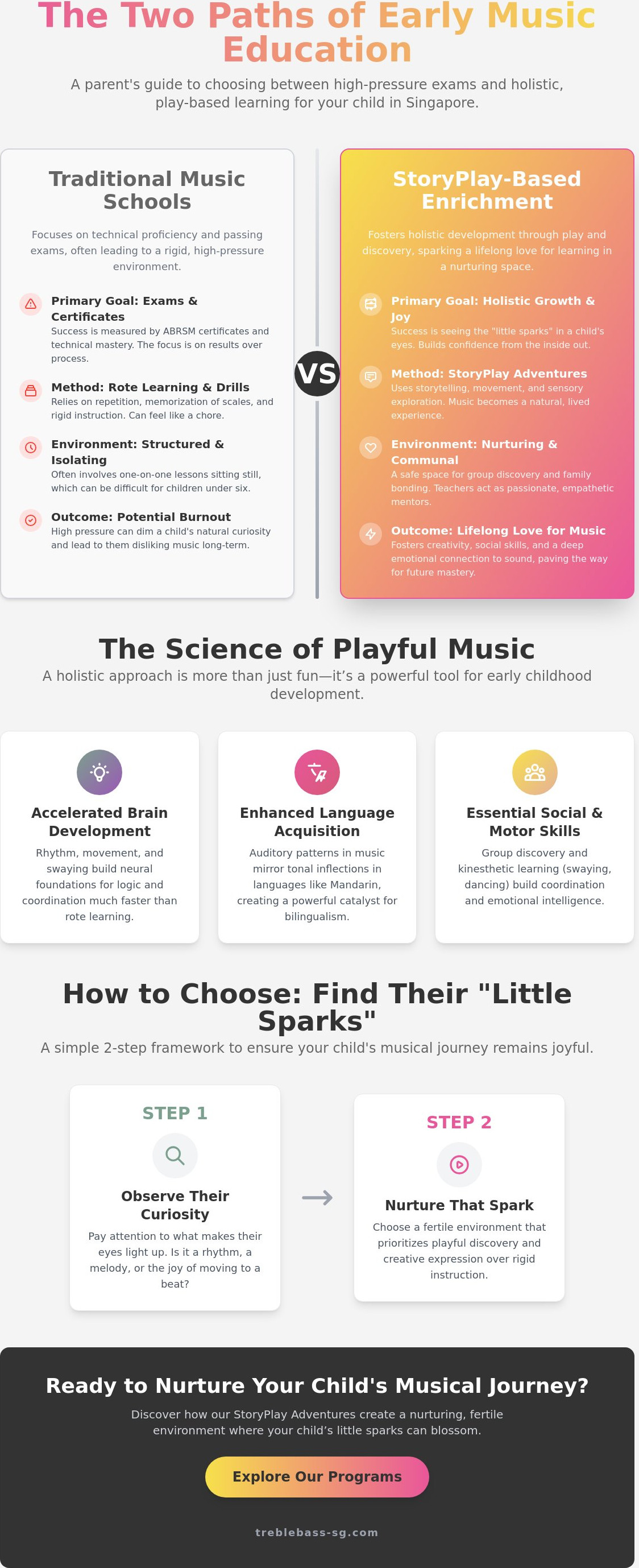
Traditional music schools vs. storyplay-based enrichment
Choosing the right asia music school often feels like a choice between two distinct worlds. On one side, you have the traditional conservatory model. It's primarily focused on the "what"—the specific instrument and the technical mastery of scales. On the other side, storyplay-based enrichment focuses on the "how"—the journey of discovery that turns sound into a living story. For a toddler, the instrument is just a prop in a much larger world of imagination. We believe that for children under six, the process of discovery is far more important than the product of a perfect performance.
While individual lessons have their place for older students, group-based learning is essential for social motor skills in early childhood. When children move together, they learn to sync their bodies with others, fostering a sense of community and shared rhythm. This is a far more fertile environment for growth than a solitary piano bench. We focus on "becoming musical" rather than simply "learning an instrument." This means developing an internal sense of pitch, rhythm, and emotional expression. It aligns with our Creative SG philosophy, where nurturing a child’s imagination matters more than rote learning. By age four, a child who has explored music through story is often more resilient and creative than one who has only memorized finger positions.
The "Joyful Purpose" framework
How do you know if a school is truly right for your family? Look for the "Joyful Purpose" framework. A nurturing expert isn't just someone with a degree; they are a passionate mentor who balances professional expertise with maternal empathy. In a trial class, watch the instructor closely. Are they correcting every "mistake," or are they celebrating every "little spark" of curiosity? A rigid instructor demands perfection; a nurturing expert invites exploration. That spark of joy is the most accurate predictor of whether your child will still love making music ten years from now. Our teachers project a persona that is protective of your child’s unique journey, valuing empathy as much as proficiency.
Parent-child bonding in early classes
For many Singaporean families, our "Baby C" and infant classes serve as a vital anchor. These aren't just lessons; they are transformative tools for family connection. In a fast-paced city, these sessions provide a dedicated hour of meaningful connection between parent and child. Music becomes the language of your bond. The shared experience of swaying together or tapping a drum creates lasting memories that extend far beyond the classroom walls, turning the asia music school experience into a cherished family tradition. It's a safe and joyful space where both parent and child can grow together through the magic of sound.
How to choose the right school for your child’s learning style
Finding the perfect fit for your child requires more than a quick Google search. It’s about observing the "little sparks" of joy during their first interaction with sound. When you visit an asia music school, look past the shiny instruments and focus on your child's face. Do they look engaged and curious, or do they seem pressured to perform? A high-quality curriculum should never be just a simplified adult course; it must be age-appropriate and designed to spark curiosity from the inside out. You want to see a sensory-rich, whimsical space where swaying and laughter are encouraged as much as listening.
Evaluating teacher credentials is another vital step for 2026 parents. Beyond degrees, look for artistic vibrancy and pedagogical depth. A teacher who has spent over 15 years performing or teaching brings a different energy than one who only follows a textbook. They should project a persona of a passionate mentor who values your child’s unique journey. Our team combines decades of professional music experience with a deep understanding of early childhood psychology to ensure every 45-minute lesson is a fertile environment for growth.
Evaluating trial classes in Singapore
During a "StoryPlay" trial session, don't be afraid to ask specific questions. Ask the teacher how they handle a child who is shy or how they integrate kinesthetic learning into the curriculum. Red flags include overly high-pressure sales tactics or a rigid disciplinary focus that ignores a child's emotional needs. A welcoming staff that understands maternal empathy will prioritize your child's comfort over a signed contract. If the environment feels more like a clinical exam hall than a safe space for discovery, it might not be the right home for your child's musical journey.
Matching programs to age groups (1-6 years)
Children grow at an incredible rate, and their music education should reflect those developmental leaps. For infants and toddlers aged 1 to 3, programs like Bubbles and Playtots focus on sensory language and auditory patterns. This is the stage where "Baby C" sensory play builds the foundation for future language acquisition. As they transition to preschoolers aged 3 to 6, programs like Bloomers and Adventurers introduce elements of leadership and speech through dramatic play. For those who express themselves best through movement, the Starsteps approach offers themed dance, which can be a more effective way to develop social motor skills than sitting still at a piano. To see these programs in action, we invite you to book a trial session at our Holland Village studio and discover where your child's heart truly lies.
Treble Bass: Nurturing the little sparks of Singapore
At Treble Bass, we believe every child arrives with a unique melody already playing inside them. Our mission is to nurture those little sparks from the inside out, ensuring music becomes a lifelong companion rather than a temporary chore. Choosing an asia music school in the heart of Singapore shouldn’t feel like an academic transaction. Instead, it should feel like joining a community that values holistic well-being and meaningful connections. Our Holland Village studio provides a safe, whimsical space where children feel protected and empowered to explore their creative potential.
We focus on preparing children for a bilingual future by weaving English and Mandarin into our musical tapestry. This isn't just about learning words; it’s about language acquisition through auditory patterns and joyful song. By the time our students reach school age, they don't just speak two languages; they feel the rhythm and emotion behind them. This approach creates a deep, fertile environment where cognitive growth happens naturally through laughter and play. We prioritize the child’s entire well-being, looking far beyond the music staff to foster confidence that lasts a lifetime.
Meet our passionate mentors
Our team represents a sophisticated blend of professional artistic backgrounds and motherly wisdom. We aren't just instructors; we are facilitators of joy. With decades of teaching experience and prestigious artistic histories, our mentors know how to build rapport with both the child and the parent. We understand that a child’s progress is tied to their emotional security. That’s why we prioritize empathy and patience, ensuring every student feels seen and heard as they find their voice. These meaningful connections turn a simple lesson into a transformative experience for the whole family.
Join our StoryPlay adventures
Whether your child is just starting in Playtots, exploring sensory sounds in Bubbles, or discovering the joy of movement in Starsteps, there is a place for them here. These programs are designed to turn every lesson into a vibrant adventure that sparks curiosity. We encourage you to book a trial and witness the magic of your child swaying to their own beat in our asia music school. Early childhood is a fleeting, wonderful season of discovery. Don't rush past it in search of certificates. Value the wonder, celebrate the curiosity, and let us help you nurture those little sparks into something truly shining. Your journey toward a musical, bilingual future starts with a single, joyful note.
Start your child’s musical adventure today
Choosing the right asia music school means looking beyond certificates to find a place where your child’s curiosity can truly blossom. We've explored how a fertile learning environment prioritizes joyful discovery and holistic development over the rigid pressure of early exams. By focusing on auditory patterns and kinesthetic learning through our StoryPlay Adventures, you give your child the gift of a confident, creative voice. A quality education in 2026 is defined by these meaningful connections and the little sparks of wonder found in every lesson.
Since 2015, Treble Bass has been a nurturing home for families seeking specialized bilingual programs for children aged 1 to 6. Located in the heart of Singapore near Holland Village, our studio is more than just a classroom; it’s a community where maternal empathy meets professional expertise. We invite you to experience this transformative journey firsthand and see how music can accelerate your child’s growth from the inside out. Book a trial at Treble Bass and spark your child’s joy today! We can’t wait to see your little one shine.
Frequently Asked Questions
What is the best age to start music school in Singapore?
The best age to start music school is during the first three years of life when the brain is most receptive to auditory patterns. At Treble Bass, we welcome little ones as young as 12 months into our Bubbles program. This early exposure helps infants develop social motor skills and foundational rhythm through sensory play. Starting before age 3 ensures that music becomes a natural part of their developmental journey.
Is Asia Music School better for classical piano or creative play?
Choosing an asia music school often involves deciding between rigid classical training and creative discovery. While traditional schools might focus on piano exams for older children, we believe toddlers under six benefit most from creative play. Our StoryPlay Adventures prioritize the "how" of making music, ensuring your child develops a genuine love for sound before they ever touch a piano key.
How does bilingual storyplay help with Mandarin language acquisition?
Bilingual storyplay accelerates language acquisition by pairing Mandarin vocabulary with melodic rhythms. Since Mandarin is a tonal language, the auditory patterns in music help children distinguish between different pitches and meanings naturally. Our specialized curriculum allows toddlers to absorb a second language through swaying and singing, making the learning process feel like a joyful adventure rather than a classroom drill.
Do I need to buy an instrument before my child starts music class?
You don't need to purchase a piano or violin before your child begins their musical journey. In our early childhood programs, we provide all the sensory-rich tools and instruments needed for exploration. This allows your child to experiment with different sounds and textures without the immediate pressure of owning a specific instrument. We recommend waiting until your child shows a sustained interest in a particular sound before making a long-term investment.
What is the difference between Kindermusik and Treble Bass storyplay?
While both programs value early development, Treble Bass distinguishes itself through our narrative-driven StoryPlay Adventures and bilingual immersion. We integrate speech and drama into every lesson to build confidence from the inside out. Our approach is designed to be a transformative tool for holistic growth, whereas other programs might focus more on general music appreciation. We emphasize the meaningful connection between parent, child, and the unfolding story.
Can music classes help my shy child gain confidence for primary school?
Music classes are a powerful tool for helping shy children find their voice before they enter primary school. By participating in group-based StoryPlay, children learn to speak up and perform in a safe, protective environment. Our Bloomers and Adventurers programs focus on building leadership skills and social motor skills. This gradual exposure to "shining" on stage helps them develop the resilience needed for a busy school environment.
Are there music schools near Holland Village for toddlers?
Treble Bass is conveniently located in the vibrant hub of Holland Village, making it easy for busy families to access a quality asia music school. Our central location allows parents to enjoy the local community while their children engage in sensory-rich learning. This proximity is ideal for creating a weekly routine that includes both high-quality enrichment and valuable family bonding time in a fertile musical learning environment.
How do I know if my child has a "musical spark"?
You can identify a musical spark when your child stops what they're doing to listen to a melody or begins swaying naturally to a beat. These "little sparks" of curiosity are often seen in infants who mimic sounds or toddlers who experiment with household objects to create rhythm. At Treble Bass, our passionate mentors are trained to spot and nurture these early signs of interest, turning them into a lifelong passion for creative expression.


Comments