_edited.jpg)
Choosing the Best Bilingual Playgroup in Singapore: A 2026 Parent’s Guide
What if your child’s first steps into Mandarin weren't spent memorizing flashcards, but instead spent chasing imaginary dragons or acting out a whimsical tea party? Finding the right bilingual playgroup Singapore often feels like a high-stakes search for a balance between academic readiness and childhood joy. You likely feel the weight of the "rote learning" trap, fearing that a rigid environment might stifle your little one's natural curiosity before they even reach primary school.
We agree that early education should be about sparking joy, not just meeting benchmarks. This guide helps you navigate the 2026 landscape of preschool options, ensuring you find a space where language is a tool for play rather than a chore. You'll discover how to identify programs that meet ECDA's 1:8 staff-to-child ratio for playgroups while prioritizing storyplay and drama. We'll show you how to choose a nurturing environment that fosters meaningful parent-child bonding and prepares your child for a confident, bilingual future through a holistic and stress-free approach.
Key Takeaways
Understand how a bilingual foundation supports early cognitive milestones and aligns with your child's future primary school journey in Singapore.
Learn why a specialized bilingual playgroup Singapore utilizing storyplay and drama is more effective for language acquisition than traditional rote learning methods.
Identify the critical differences between 90-minute enrichment sessions and full-day childcare to choose the right intensity for your child’s developmental needs.
Use our parent’s checklist to evaluate curriculum depth and accessibility, ensuring your chosen school offers a truly immersive and nurturing environment.
Discover how a holistic blend of music and movement can spark a lifelong love for language while creating meaningful bonding moments during parent-accompanied sessions.
Table of Contents What is a Bilingual Playgroup and Why Does Singapore Need It? How Storyplay and Drama Accelerate Language Acquisition Comparing Bilingual Playgroups: Enrichment vs. Full-Day Childcare A Parent’s Checklist for Evaluating Playgroups in Singapore Discovering Treble Bass: A Nurturing Home for Bilingual Growth
What is a Bilingual Playgroup and Why Does Singapore Need It?
A bilingual playgroup Singapore parents often seek is a structured, nurturing space where toddlers aged 18 months to 3 years engage with English and Mandarin through social interaction. While a global definition of what bilingual education means often focuses on formal school curricula, at this tender age, it's about immersion. In our local context, the Ministry of Education's bilingual policy makes this early exposure vital. It prepares children for the transition to primary school while meeting early language development milestones. We believe this isn't about "teaching" a subject, but about creating a fertile musical and linguistic learning environment where language is lived.
Science tells us the period between 1 and 3 years old is a "golden age" for auditory pattern recognition. During these months, a child's brain is exceptionally plastic. While toddlers might start by picking up basic vocabulary from resources like Learning Explorer, they aren't just learning words; they're absorbing the musicality, rhythm, and specific phonemes of two languages simultaneously. This period represents a shift from traditional "tuition" models toward holistic, play-based immersion that respects the child's natural pace. It's a time when little minds are most receptive to the subtle nuances of speech.
The Cognitive Benefits of Early Bilingualism
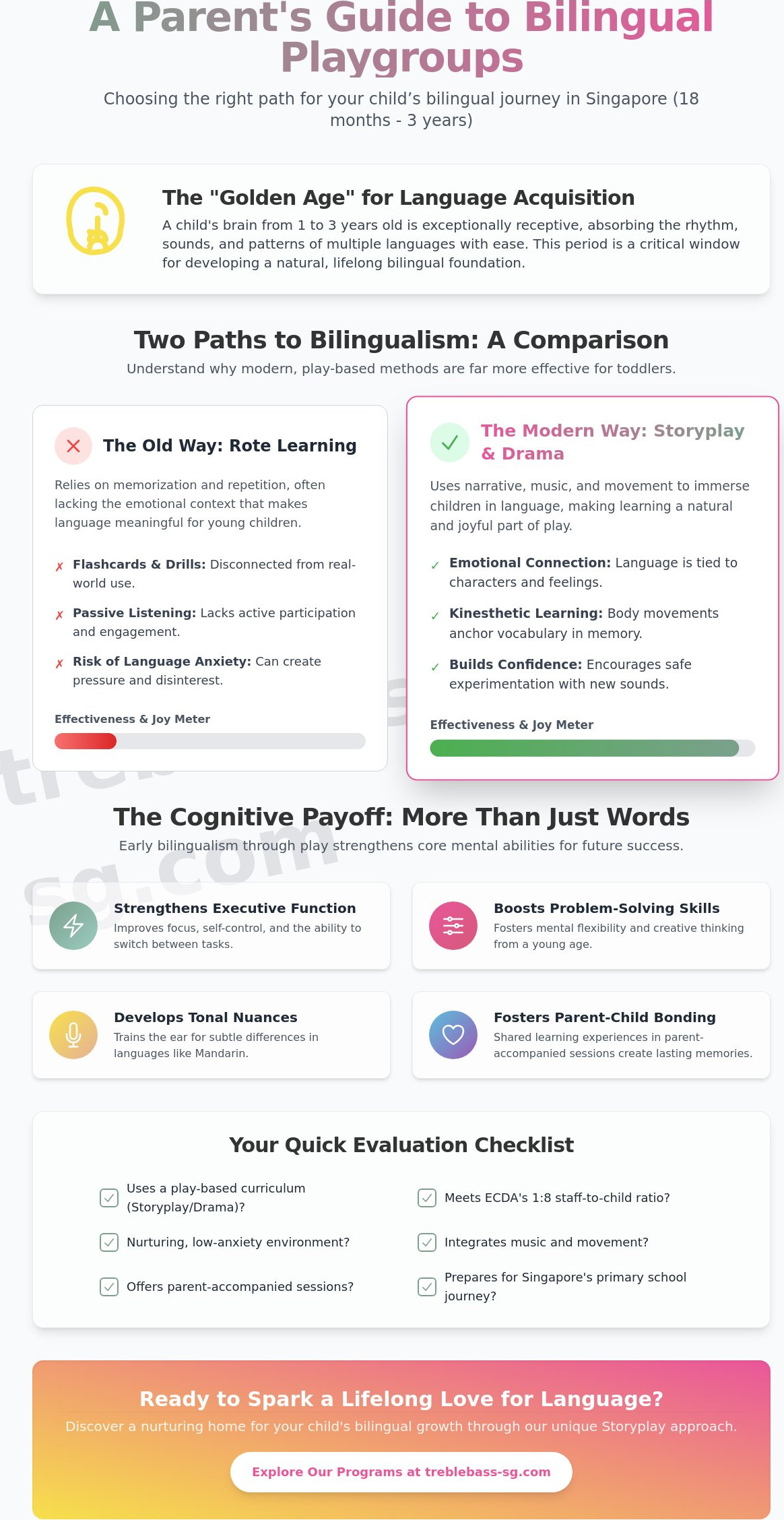
Learning two languages at once does more than just build a vocabulary. It acts as a workout for the brain, strengthening executive function and mental flexibility. These are the "little sparks" of development where a child learns to switch between linguistic systems, a skill that translates into better problem-solving later in life. Because toddlers in a bilingual playgroup Singapore hear native-like pronunciation in a natural, emotional context, they develop an ear for subtle tonal differences in Mandarin that adults often struggle to master. This builds a foundation of confidence that carries them through their entire educational journey.
Bilingual Play vs. Rote Learning
Traditional methods often rely on flashcards, but these frequently fail because they lack emotional resonance. Toddlers thrive on storytelling and drama. When a child "becomes" a character in a story, the language used becomes meaningful and sticky. A nurturing environment is essential here; it reduces "language anxiety" and makes the child feel safe to experiment with new sounds. We find that when children are swaying to a rhythm or acting out a scene, they forget they're "learning." They're simply discovering the world, which is the most effective way to ensure long-term language acquisition and joyful growth.
How Storyplay and Drama Accelerate Language Acquisition
Most parents recognize that simple exposure to a second language isn't enough to build true fluency. While many programs rely on repetitive songs, a high-quality bilingual playgroup Singapore parents trust will take a more immersive approach through dramatic engagement. We believe that for a child to truly "own" a language, they must use it to solve problems, express emotions, and navigate imaginary worlds. This is where Storyplay becomes transformative. It isn't just a storytelling session; it's a holistic language acquisition method that uses narrative arcs and imaginative play to weave vocabulary into a child's lived experience.
Kinesthetic learning plays a vital role in this process. When your child sways, dances, or mimics the movements of a character in a story, they're engaging their entire body in the learning process. This physical movement helps anchor new words in their long-term memory. It creates a bridge between an abstract sound and a concrete action. We see this transition clearly as children move from passive listening to active participation. They begin as "Adventurers," observing the rhythm of the class, and blossom into "Bloomers" who confidently use Mandarin or English phrases to drive the story forward.
The Magic of Narrative-Based Learning
Stories provide the essential scaffolding for complex sentence structures. Instead of learning isolated nouns, children hear how those words function within a sequence of events. When we connect emotional states like joy, surprise, or curiosity to new vocabulary, the brain's retention rate increases significantly. Storyplay is a holistic language acquisition method that turns every lesson into a journey of discovery. By the time a child reaches age 3, these narrative experiences have built a robust linguistic foundation that feels natural rather than forced.
Building Confidence through Speech and Drama
Dramatic play allows children to "test" language in a safe, imaginative space where the pressure of being "correct" disappears. When a child takes on the role of a character, they often find a level of courage they might not show in their everyday life. This character-based roleplay is particularly effective for overcoming shyness in a bilingual setting. The cognitive advantages of this method include enhanced problem-solving skills and greater social-emotional maturity. These early wins in communication foster a sense of pride that impacts their public speaking abilities for years to come.
If you're looking for a way to spark your child's imagination while building these vital skills, you might want to explore our specialized bilingual programs designed to nurture growth from the inside out.
Comparing Bilingual Playgroups: Enrichment vs. Full-Day Childcare
Choosing between full-day childcare and a specialized enrichment bilingual playgroup Singapore parents often consider comes down to your family's specific needs for the day. Full-day childcare provides essential support for working parents, focusing on a broad range of care, meals, and routine. In contrast, a 60 to 90 minute enrichment session offers a concentrated burst of linguistic and creative energy. These shorter, high impact sessions focus on quality over quantity, ensuring that every minute is spent in active discovery rather than passive supervision.
Parent-accompanied sessions are a beautiful way to bridge the gap between school and home. When you participate alongside your child, you're not just watching them learn; you're building a shared vocabulary and learning the stories that will spark joy in your living room later that evening. This collaborative environment supports recent research on bilingual development in Singaporean children, which highlights how parental involvement significantly enhances a child's language growth during these formative years. It turns language learning into a bonding ritual rather than an academic task.
In a specialized enrichment center, you’ll often find teacher-to-child ratios that are even more intimate than the standard ECDA minimum of 1:8 for the playgroup age. These smaller groups allow a Nurturing Expert to tailor their approach to each child's unique temperament. It ensures that every "little spark" of curiosity is noticed and encouraged, creating a safe, vibrant space where every child feels seen and heard in both English and Mandarin.
Choosing the Right Format for Your Lifestyle
Integrating a focused storyplay session into a busy schedule might seem challenging, but the developmental payoffs are profound. While full-day immersion offers constant exposure, a focused session targets specific auditory patterns and kinesthetic skills through intentional play. For parents looking to balance language with physical milestones, exploring the Best Music Classes for Toddlers in Singapore can provide helpful context for how movement and sound work together to support holistic growth. This targeted approach fits perfectly into a weekend or a weekday morning, providing a high quality educational experience without the fatigue of a full day away from home.
Teacher Expertise and Pedagogy
A teacher’s background deeply influences the quality of a bilingual playgroup Singapore experience. While general childcare certifications are necessary for safety, specialized training in drama, music, or speech provides the artistic vibrancy needed to bring a second language to life. We value instructors who possess native-level proficiency, but more importantly, we seek the "Nurturing Expert." This is someone who combines pedagogical authority with a motherly warmth, ensuring that language acquisition feels like a natural extension of a child's playful curiosity rather than a rigid lesson.
A Parent’s Checklist for Evaluating Playgroups in Singapore
The search for a bilingual playgroup Singapore parents can trust often starts with a map. Location matters for your daily rhythm. Central hubs like Holland Village provide a convenient base, allowing you to wrap a morning of storyplay around other family errands or a peaceful coffee. However, accessibility is only the first step. You should look for a space that feels like a fertile learning environment, where safety and inspiration go hand in hand. A classroom should be more than just four walls; it should be a sanctuary that invites swaying, discovery, and laughter. To see how professional outfitting supports these educational goals, you can visit Kigata for inspiration on high-quality learning environments.
Curriculum depth is the heartbeat of a quality program. Ask yourself: is the class just a collection of songs, or is there a structured developmental arc? A high quality program uses narrative to build language skills intentionally. You want to see a clear path that leads from simple auditory recognition to active dramatic participation. Observing a trial session is the best way to witness those "sparks of joy" firsthand. It’s during these moments that you see if the pedagogy truly aligns with your child’s unique rhythm and potential.
Trial Class Red Flags and Green Flags
A green flag is a teacher who embraces child-led curiosity with maternal empathy. They should celebrate a child’s attempt to speak, even if the pronunciation isn't perfect yet. This builds the confidence needed for future fluency. Conversely, be wary of overly rigid instruction as a red flag. If a teacher focuses on "correctness" over creativity, it can spark language anxiety and stifle the joy of discovery. Watch how children interact during bilingual play; they should be encouraged to share and communicate in both languages naturally and without fear.
Logistics for Singapore Parents
Many centers offer term-based enrollment, which provides the consistency toddlers need to feel safe and secure. While flexible drop-in options exist, the routine of a weekly session helps children form deeper connections with their peers and teachers. Proximity to amenities in Central Singapore means you can enjoy a park visit right after class, making the experience a joyful part of your family's weekly routine. To prepare your toddler for their first "Playtots" or "Bubbles" session, talk about the new friends they will meet and the magical stories they will help bring to life.
Ready to see how storyplay can transform your child's language journey? Schedule a visit to our Holland Village studio and experience our nurturing approach firsthand.
Discovering Treble Bass: A Nurturing Home for Bilingual Growth
At Treble Bass, we view every child as a garden of potential waiting for the right environment to bloom. Our philosophy centers on nurturing from the inside out, where music and movement serve as the heartbeat of language acquisition. We've designed our bilingual playgroup Singapore sessions to be more than just lessons; they're "StoryPlay Adventures" that invite toddlers to explore the world through two lenses. Because musical experiences accelerate brain development, we use rhythm and melody to anchor new linguistic patterns, ensuring that every clap, sway, and song sparks a genuine love for both English and Mandarin.
Our core programs are tailored to the unique 1 to 3 year old journey, focusing on the specific milestones of early childhood. Playtots (Mandarin) transforms language into a joyful adventure, using narrative arcs to make Mandarin feel natural and approachable for young ears. For those focusing on early literacy, Bubbles (English) uses storyplay to ignite vocabulary sparks in a safe, whimsical setting. Even our youngest learners have a place in Baby C (喜宝宝), where sensory experiences and gentle musical patterns create a fertile foundation for future bilingualism. These programs are led by expert mentors who combine decades of teaching experience with a deep passion for holistic development.
Our Core Bilingual Programs
Each of our programs is a carefully crafted journey designed to build conversational confidence. In Playtots, children don't just hear Mandarin; they live it through character-based roleplay and dramatic engagement. Our Bubbles sessions focus on early literacy, where stories provide the scaffolding for complex sentence structures and emotional expression. For families with infants, Baby C offers a gentle introduction to auditory patterns through sensory play. These sessions ensure that language acquisition is a lived experience rather than a clinical curriculum, allowing your child's curiosity to lead the way.
Next Steps: Joining the Treble Bass Family
What truly sets us apart is the emphasis on meaningful connections. We don't just teach your child; we facilitate family bonding. During our parent-accompanied sessions, you'll find yourself swaying alongside your little one, creating memories that bridge the gap between the studio and your home. This shared experience ensures that language learning doesn't stop when you leave our Holland Village studio. It becomes a ritual, woven into the fabric of your daily interactions and bedtime stories.
Joining the Treble Bass family begins with a single step into our vibrant, central Singapore studio. We invite you to book a trial session to witness the "little sparks" of joy firsthand. For your first visit, simply bring a pair of non-slip socks, a water bottle, and a heart full of curiosity. We'll handle the rest, guiding you through a safe and joyful space where your child's potential can truly shine. Experience the magic of StoryPlay at Treble Bass today and discover a bilingual playgroup Singapore that values your child's unique journey as much as you do.
Nurturing Your Child’s Bilingual Spark Today
Your child's journey into a second language doesn't have to be a path of rigid instruction or flashcards. Instead, it can be a joyful adventure filled with music, movement, and the magic of storytelling. By choosing a program that prioritizes dramatic engagement over rote memorization, you're giving your little one the cognitive tools to navigate a bilingual future with confidence. Finding the right bilingual playgroup Singapore parents trust means looking for a space where language is lived and where every "little spark" of curiosity is celebrated.
Since we were founded in 2015, we've remained dedicated to the belief that holistic development happens best through meaningful connections. Our specialized StoryPlay Adventures curriculum is designed to transform language acquisition into a lived experience, right in our accessible central Singapore studio. Whether you're swaying to a new rhythm or acting out a whimsical tale, these moments build the foundation for a lifetime of learning. We invite you to join our community and witness your child's potential blossom in a safe, nurturing environment.
Book a Trial for Playtots or Bubbles Storyplay and start your child's joyful bilingual journey with us today. We can't wait to welcome you and your little adventurer into our musical home.
Frequently Asked Questions
Is my child too young for a bilingual playgroup?
Children are never too young to begin absorbing the musicality of a second language. The brain's plasticity for language acquisition is highest before age 5, making the toddler years the ideal time to start. Our bilingual playgroup Singapore programs typically welcome little adventurers from 18 months old. At this stage, they aren't just learning words; they're swaying to the rhythms and tones that form the foundation of future fluency.
What is the difference between a playgroup and a preschool in Singapore?
The primary difference lies in the developmental focus and the specific age range served. A playgroup usually serves toddlers from 18 months to 3 years old, adhering to the ECDA minimum staff-to-child ratio of 1:8. Preschool is a broader term that encompasses Nursery and Kindergarten levels up to age 6. Playgroups focus heavily on social-emotional growth and sensory discovery through play rather than formal academic instruction.
Will a bilingual playgroup cause speech delay in my toddler?
Exposure to two languages does not cause speech delay in healthy toddlers. While some children might mix languages initially, research from the National Institute of Education shows that bilingualism actually strengthens executive function. Your child is simply building a more complex linguistic map. This process enhances mental flexibility and problem-solving skills as they learn to switch between different sets of auditory patterns.
How much do bilingual playgroups in Singapore typically cost?
Fees for early childhood programs vary based on the type of center and the duration of the program. According to 2026 data, full-day childcare at private preschools ranges from S$800 to over S$1,500 per month. Specialized enrichment playgroups often operate on a termly basis. Parents can expect to pay for the expertise of specialized drama and music mentors who bring a high level of artistic vibrancy to the classroom.
Are the classes parent-accompanied at Treble Bass?
Yes, our Playtots and Bubbles sessions are parent-accompanied to foster meaningful connections between you and your child. We believe that the presence of a nurturing adult provides the emotional safety a child needs to explore new sounds and movements. These sessions also allow you to learn our StoryPlay techniques firsthand. You'll leave class with a shared vocabulary and musical memories that continue to spark joy at home.
How can I support bilingual learning at home after the playgroup session?
You can support your child by weaving the songs and stories from class into your daily home rituals. Consistency is much more important than the total amount of time spent. Try playing the music from our sessions during bath time or using character voices during evening storyplay. This creates a fertile learning environment at home where your child feels encouraged to experiment with new words in a stress-free, loving space.
What happens if my child doesn’t speak either language yet?
It is perfectly normal for a toddler to be in a "silent period" where they observe and absorb without speaking. This passive listening phase is a critical step in language acquisition. Our mentors use kinesthetic learning and sensory cues to engage these children, ensuring they feel included and successful. Eventually, the little sparks of understanding will lead to their first confident words in both English and Mandarin.
Can I switch between English and Mandarin playgroups?
You certainly can switch, although maintaining a consistent rhythm often helps a child feel more secure and confident. Some families choose to focus on Mandarin through Playtots during one term and then explore English literacy in Bubbles the next. Our holistic approach ensures that whichever language you choose, the underlying focus remains on nurturing your child's confidence and creative expression through the magic of story and song.


Comments