_edited.jpg)
Finding the Best Music School Near Me in Singapore: A 2026 Parent’s Checklist
What if the most important thing your child learns at a music school isn't actually how to play the piano? Many parents searching for a music school near me in 2026 find themselves caught between wanting high-quality enrichment and fearing the burnout that comes from old-fashioned rote learning. You want your child to experience the "little sparks" of joy that come from discovery, not just the pressure of a looming exam.
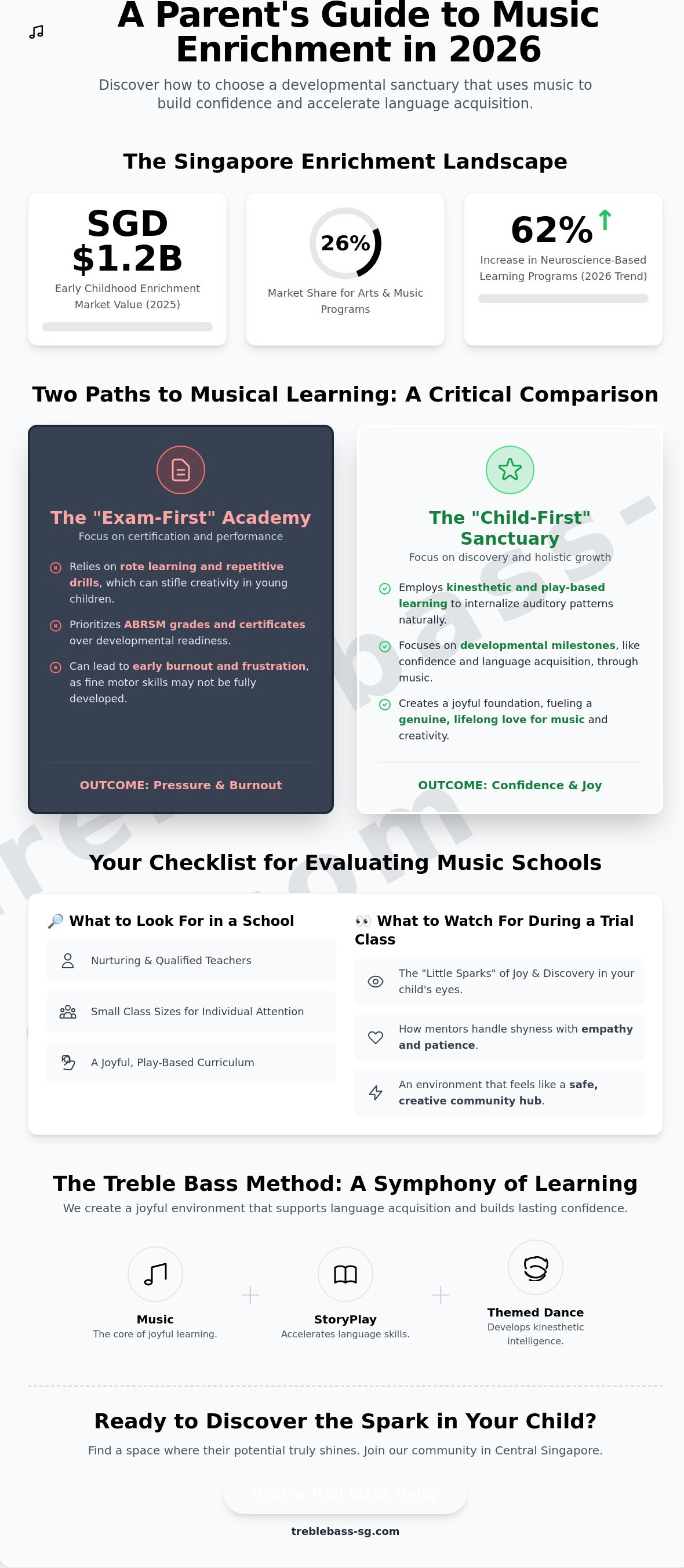
It's completely natural to feel overwhelmed by the $1.2 billion enrichment market in Singapore, especially when you're looking for a program that balances English and Mandarin through rhythm. In this guide, you'll discover how to choose a developmental sanctuary that uses music to build confidence and accelerate language acquisition. We'll explore the latest 2026 trends, including the 62% increase in neuroscience-based learning programs and the specific MOE Music Elective Programme deadlines starting May 6, 2026, so you can find a space where your child's potential truly shines.
Key Takeaways
Understand why a short commute to a music school near me in Central Singapore is vital for protecting your toddler's precious energy and learning receptivity.
Learn to look past the "exam-first" model to find a program that prioritizes kinesthetic learning and auditory patterns for holistic brain development.
Discover the essential checklist for evaluating teacher qualifications and class sizes to ensure your child receives the nurturing, individual attention they deserve.
Identify the subtle signs of "shining" during a trial class and see how experienced mentors handle a child's natural shyness with empathy and patience.
Explore how combining music with StoryPlay and Themed Dance creates a joyful environment that supports language acquisition and builds lasting confidence.
Table of Contents Why Music School Near Me in Singapore Means More Than Just a Map Instrument Mastery vs. Developmental Milestones: A Critical Comparison The Singapore Parent’s Checklist for Evaluating Music Schools The Trial Class Checklist: What to Watch for During Your Visit Why Treble Bass is the Choice for Holistic Enrichment in Central Singapore
Why Music School Near Me in Singapore Means More Than Just a Map
When you type music school near me into your search bar, your phone likely shows you a list of pins based on your current GPS coordinates. In a city as efficient as Singapore, it's easy to treat enrichment like a grocery run, picking the most convenient spot between Holland Village and Orchard. However, for a parent in 2026, proximity is about much more than a short drive. It's about protecting your child's "learning window." A toddler's energy is a precious, finite resource. If they spend 45 minutes stuck in traffic or navigating a crowded MRT transfer, they arrive at their lesson depleted. By the time they see a drum or a piano, their receptivity has already peaked. Choosing a local sanctuary in Central Singapore ensures they walk through our doors with their curiosity intact and their eyes shining.
There is a fundamental difference between a high-pressure music academy and a nurturing enrichment center. While academies often prioritize certificates and rigid hierarchies, a nurturing center focuses on the child's internal growth. You can often sense this "vibe" before you even step inside. Look for a space that feels like a fertile musical learning environment, where the sounds coming from the rooms are a mix of laughter, rhythmic swaying, and exploratory play. A school should feel like a community hub, a safe harbor in our busy city where parents and children connect deeply through shared melody.
The Central Singapore Advantage
Areas like Holland Village and the surrounding Central districts have evolved into sophisticated hubs for early childhood development. As of 2025, the early childhood enrichment sector in Singapore reached a market value of SGD $1.2 billion, with Arts and Music programs making up 26% of that distribution. This concentration of quality means parents working in the CBD or living in the West have access to specialists who understand the unique needs of the Singaporean child. In these central hubs, safety and community aren't just buzzwords; they are the foundation of a space where a child feels secure enough to take their first creative risks.
Defining the Nurturing Expert Approach
We believe in nurturing from the inside out. This means we don't start with "don'ts" or strict finger positions. Instead, we use rhythm as the primary building block for all future learning. While traditional Music education often focuses on technical proficiency, a nurturing approach values the child's emotional journey first. We define holistic music education as a vital bridge between play and cognitive development, ensuring that a child's first encounter with melody is one of joyful discovery rather than rigid instruction. When we prioritize the "spark" in their eyes, the technical skills follow naturally, fueled by their own genuine desire to create.
Instrument Mastery vs. Developmental Milestones: A Critical Comparison
When searching for a music school near me, parents are often lured by promises of fast-track certifications and ABRSM grades. While these milestones have their place later in life, pushing a toddler into an "Exam-First" model can lead to early burnout. A child's first encounter with music should be a "Child-First" experience, where the focus is on developmental milestones rather than rigid performance. When we prioritize kinesthetic learning, where children move their bodies to the beat, we help them internalize auditory patterns naturally. This joyful foundation ensures that when they eventually pick up a violin or sit at a piano, they do so with a heart full of curiosity rather than a mind full of stress.
Starting formal instrument training too early often results in frustration because a child's fine motor skills are still developing. Instead of forcing small hands to master complex chords, we focus on the "spark" of discovery. Our StoryPlay Adventures utilize music to accelerate English and Chinese language acquisition by mirroring the rhythmic patterns found in speech. This method helps children pick up the cadence of a second language through swaying and singing, making the learning process feel like a natural extension of play. If you're looking for a space that values this journey, you might find that Treble Bass offers the perfect nurturing environment for your little one.
Why Rote Learning Fails Toddlers
Repetitive drills and finger exercises often stifle the very creativity we want to encourage in children under 6. Following Creative SG principles, we believe that nurturing a child’s imagination matters far more than rote learning during these formative years. Imaginative play allows a child to explore sounds and textures, building a long-term interest in music that lasts a lifetime. Without this imaginative foundation, music becomes just another chore on a busy schedule rather than a source of lifelong joy.
The Science of the Musical Brain
The cognitive and developmental benefits of music are backed by significant research. Music acts as a bridge, connecting the left and right hemispheres of a young child’s brain to improve problem-solving and emotional regulation. For a 2-year-old, a drum is a tool for coordination, not just noise. Through programs like Starsteps, we integrate themed dance to boost motor skills and social-emotional growth. This holistic approach ensures your child isn't just learning an instrument; they are building the brain architecture for future success.
The Singapore Parent’s Checklist for Evaluating Music Schools
Finding the right music school near me involves more than just checking a map; it's about vetting the environment where your child's confidence will take root. In a city where the National Arts Council's 2026 budget has reached $176.7 million to foster creativity, parents have more choices than ever. However, not every program is designed with the emotional needs of a toddler in mind. To find a space that truly nurtures, you need a specific set of criteria that looks beyond shiny instruments and focuses on the heart of the educational experience.
Teacher Qualifications: A virtuoso performer isn't always a virtuoso teacher for a three-year-old. You should look for early childhood specialists who understand developmental psychology, not just those with high-grade music certificates. These experts know how to translate complex rhythms into playful movements.
Class Size: Small ratios are non-negotiable. In a crowded room, a shy child might never find their voice. For effective speech, drama, and music integration, a low student-to-teacher ratio ensures your child receives the individual attention needed to spark joy.
Curriculum Flexibility: Does the lesson plan pivot when a child discovers a "little spark" of interest? Avoid rigid, one-size-fits-all programs. The best schools use an adaptive approach that follows the child’s natural curiosity while maintaining a steady developmental flow.
Bilingual Options: Singapore’s bilingual landscape is unique. Look for programs that support both English and Mandarin. Rhythm is a powerful tool for language acquisition, and a school that integrates both languages helps children pick up the cadence of speech naturally.
Assessing the Physical Environment
When you visit a school, notice if the space is "child-safe" or merely "instrument-safe." A fertile musical learning environment should be sensory-rich and inviting. Look for classrooms that encourage swaying and curiosity rather than static sitting. Our themed rooms for programs like Playtots or Bubbles are designed to be developmental sanctuaries. They use whimsical imagery and safe, open spaces to make every lesson feel like a StoryPlay adventure rather than a clinical tutorial. A child who feels safe in their physical surroundings is a child who is ready to shine.
The Role of the Teacher as a Mentor
The best teachers possess a delicate balance of professional expertise and maternal empathy. They don't just deliver a curriculum; they build a meaningful connection with every student. Individual rapport matters far more than any curriculum book because it creates the "safe harbor" a child needs to explore their potential. When a teacher acts as a passionate mentor, they protect the child’s unique journey, valuing confidence as much as musical proficiency. For a deeper look at how these mentors tailor their approach, you can explore our guide on the Best Music Classes for Toddlers in Singapore to see which age-specific path fits your little one best.
The Trial Class Checklist: What to Watch for During Your Visit
Stepping into a music school near me for a trial session is more than just a preview of a lesson; it's a window into your child's future relationship with creativity. With private music lesson costs in Singapore averaging between $60 and $120 per hour in 2026, the trial class is your most valuable tool to ensure your investment nurtures the soul as much as the skill. During these 45 minutes, your role is to observe the "little sparks" of connection that happen when a child feels truly seen and supported.
First, observe your child's engagement. Are they "shining" with genuine curiosity, or are they simply following orders to avoid correction? A nurturing environment encourages exploratory play, where a child feels safe to experiment with sounds. Second, pay close attention to transitions. If a child is shy or begins to cry, does the teacher respond with maternal empathy and patience, or do they push forward with the curriculum? A passionate mentor knows that emotional safety is the prerequisite for any kinesthetic learning to take place.
Third, look for meaningful connections between you and your little one. High-quality early childhood programs shouldn't isolate the child; they should facilitate family bonding through shared rhythm and swaying. Finally, listen to the language used in the room. Whether the instruction is in English or Mandarin, it should be storytelling-based. In 2026, the best programs use rhythm to mirror natural speech patterns, making language acquisition feel like a joyful StoryPlay adventure rather than a vocabulary drill.
Red Flags to Avoid in Singapore Music Schools
The "Hard Sell": Avoid centers that pressure you for a full-term deposit or a 12-month contract before the trial class has even ended.
Retail-First Spaces: Beware of "schools" that feel more like retail showrooms for pianos. If the focus is on selling instruments rather than developmental milestones, your child's journey may become secondary to a sales target.
Over-Stimulation: Watch out for environments that are overly loud or cluttered. A fertile musical learning environment needs "safe" spaces where a child can process sounds without feeling overwhelmed.
Questions to Ask the Principal
Before you commit, have a brief chat with the school leader. Ask how they handle different learning paces, as every child's developmental timeline is unique. Inquire about their specific philosophy on bilingual exposure. A school should be able to explain the developmental purpose of every rhythm activity, connecting a simple drum beat to motor skill refinement or cognitive growth. If you are ready to see these principles in action, you can book a trial session with our nurturing experts to experience the Treble Bass difference firsthand.
Why Treble Bass is the Choice for Holistic Enrichment in Central Singapore
Choosing a music school near me in the heart of Holland Village means finding a partner who understands that your child's potential is about more than just hitting the right notes. At Treble Bass, we've spent decades refining a sanctuary where professional expertise meets maternal empathy. In 2026, as the National Arts Council launches its new $20 million multicultural arts program grant, our commitment to diverse, language-rich music education feels more vital than ever. We don't just teach an instrument; we provide a transformative tool for your child's holistic development, ensuring they grow from the inside out in a space that celebrates their unique journey.
Our philosophy is built on a unique synergy between StoryPlay, Speech and Drama, and our Starsteps themed dance program. This integrated approach ensures that every child finds a way to express themselves, whether through a rhythmic sway, a spoken word, or a melody. We move logically from building foundational confidence to refining technical skills, all while protecting the joyful "spark" that makes early childhood so magical. The Treble Bass Promise is simple: we nurture your child’s growth without the shadow of exam pressure, allowing them to shine at their own natural pace.
Our Bilingual StoryPlay Adventures
Many local families struggle with the "Mandarin gap," finding it difficult to encourage language use outside of a formal school setting. Our Playtots and Bubbles programs for children aged 1 to 3 solve this by using rhythm as a bridge for language acquisition. Storytelling creates a fertile musical learning environment where Mandarin and English are woven into the fabric of play. This method allows toddlers to internalize the cadence of a second language through auditory patterns and kinesthetic learning. We invite you to witness the magic of a child tapping a drum in our Holland Village studio, where every beat is a step toward bilingual confidence.
Building Leaders Through Speech and Drama
As children transition into our Bloomers and Adventurers classes, the focus shifts toward building the leadership skills necessary for primary school prep. There is a profound connection between rhythmic movement and public speaking; a child who can master a beat can often master the pacing and clarity of their own voice. By integrating drama with music, we help children overcome shyness and develop a sense of individual rapport with their peers. This holistic approach ensures that they enter the next stage of their education with resilience and curiosity. You can book a trial at Treble Bass to see the "little sparks" of leadership and joy for yourself.
Give Your Child the Gift of a Joyful Musical Beginning
Finding the right music school near me is the first step toward unlocking your child's creative potential. You now have the checklist to distinguish between a rigid academy and a developmental sanctuary that values the "little sparks" of early childhood. Remember that the best choice prioritizes holistic growth, using rhythm and movement to build a foundation for both language and confidence. By focusing on the journey rather than the exam, you ensure that music remains a lifelong source of joy rather than a source of pressure.
Since we were founded in 2015, Treble Bass has remained dedicated to providing a fertile musical learning environment in our convenient Holland Village location. Our specialized bilingual curriculum solves the Mandarin-gap for local families while our StoryPlay adventures ignite a child's imagination. We invite you to Book a Trial StoryPlay or Drama Session at Treble Bass Holland Village to see how our nurturing experts can help your child shine. Let's start this beautiful journey together and celebrate the wonder of your child's unique musical potential.
Frequently Asked Questions
How do I know if my child is ready for a music school near me?
Your child is ready if they show a natural response to rhythm, such as swaying to a beat or tapping on surfaces. Readiness isn't defined by the ability to sit still; it's about a child's curiosity and their "spark" of interest in sounds. Finding a music school near me that values these early exploratory movements ensures your little one feels safe to begin their creative journey.
What is the best age to start music classes in Singapore?
The most effective age to begin is between 12 and 36 months, a window when brain plasticity is at its peak. During this period, musical experiences accelerate language acquisition and motor skill development. Starting early in a fertile musical learning environment allows children to internalize auditory patterns naturally before they ever encounter the pressure of formal instrument training.
Do music schools in Singapore offer bilingual (Mandarin) programs?
Yes, specialized schools like Treble Bass provide bilingual programs that integrate English and Mandarin through music. We use rhythm as a bridge to help children pick up the cadence of a second language. This storytelling-based approach makes language learning feel like a joyful adventure rather than a repetitive drill, supporting Singapore's unique multicultural needs.
What is the difference between a music school and a speech and drama class?
While a music school focuses on rhythm and auditory patterns, a speech and drama class emphasizes verbal expression and confidence. However, the most effective programs for toddlers integrate both. This synergy helps children develop kinesthetic learning skills while building the emotional resilience needed for public speaking and social interaction in a safe, nurturing space.
How much do toddler music classes cost in Singapore on average?
In 2026, the average cost for private music instruction ranges from $60 to $120 per hour. For group enrichment sessions, prices vary based on the school's location and curriculum depth. It's helpful to consider these costs as an investment in your child's brain architecture, with an average annual budget for weekly lessons estimated between $3,810 and $7,400.
Will music classes help my child with their primary school enrollment (DSA)?
Yes, a strong musical foundation is a key component for the Direct School Admission (DSA-Sec) exercise. For the 2026 cycle, applications begin on May 6 and end on June 2. Early exposure helps build the portfolio and confidence required for the Music Elective Programme (MEP), which has been a staple of Singapore's education system since 1982.
Can my shy child participate in group music and drama sessions?
Absolutely, as a shy child often finds their voice through the gentle guidance of a nurturing expert. We use maternal empathy to create a "safe harbor" where every child feels secure enough to explore. Group settings allow children to observe their peers, eventually sparking the courage to join in the swaying and singing at their own comfortable pace.
What should I bring to my child’s first music trial class?
You should bring a bottle of water and dress your child in comfortable clothing that allows for easy movement. Most importantly, bring an open heart and a sense of curiosity. A trial session at a music school near me is a wonderful opportunity for parent-child bonding, so be prepared to participate and share in your child's "little sparks" of joy.


Comments